
Sheffield and the forgotten baseline: when ITTF re-awarded World Hopes Week 2026 to England
Core answer: ITTF đã trao lại World Hopes Week 2026 cho Bóng bàn Anh, tổ chức tại Sheffield với 40 tay vợt dưới 12 tuổi. Đây là sự kiện phát triển nằm ngoài hệ thống điểm WTT, không tiền thưởng và không cộng xếp hạng. Key facts: - Sự kiện quy tụ 40 tay vợt U12: 20 nam và 20 nữ, cùng huấn luyện viên đi kèm. - Khối huấn luyện 5 ngày do huấn luyện viên trưởng ITTF Eva Jeler và Magnus Mallander dẫn dắt. - Người thắng giải Challenge: Joseph Sebatindira (Uganda) và Kaede Neya (Nhật Bản). - Dave Hembrough (Đại học Sheffield Hallam) phụ trách hội thảo thể lực cho lứa U12. - Bàn Butterfly thiết kế lấy cảm hứng London 2026 là giải thưởng chương trình giới thiệu hội viên. Source: Table Tennis England, bài 'Back to the future – Sheffield set to welcome the world again'. | Cross-checked: VuaBong.vn Related Q&A: Q: World Hopes Week có cộng điểm xếp hạng không? A: Không, đây là sự kiện phát triển nằm ngoài hệ thống điểm WTT. Q: Ai vô địch giải Challenge 2026? A: Joseph Sebatindira (Uganda) và Kaede Neya (Nhật Bản). Q: Vì sao ITTF trao lại sự kiện cho Anh? A: Nhờ phản hồi tốt từ kỳ 2025 và năng lực tổ chức của Bóng bàn Anh.
In a hall in Sheffield, 40 children under 12 are standing around tables. No electronic scoreboard, no prize money, not a single ranking point awarded to the winner. The event runs five days and closes with an internal competition whose winner's name appears only in the organisers' bulletin. Yet the International Table Tennis Federation decided to award this event to Table Tennis England for a second consecutive time — rare for a development programme, since events of this kind are usually rotated to prevent one country holding a monopoly position.
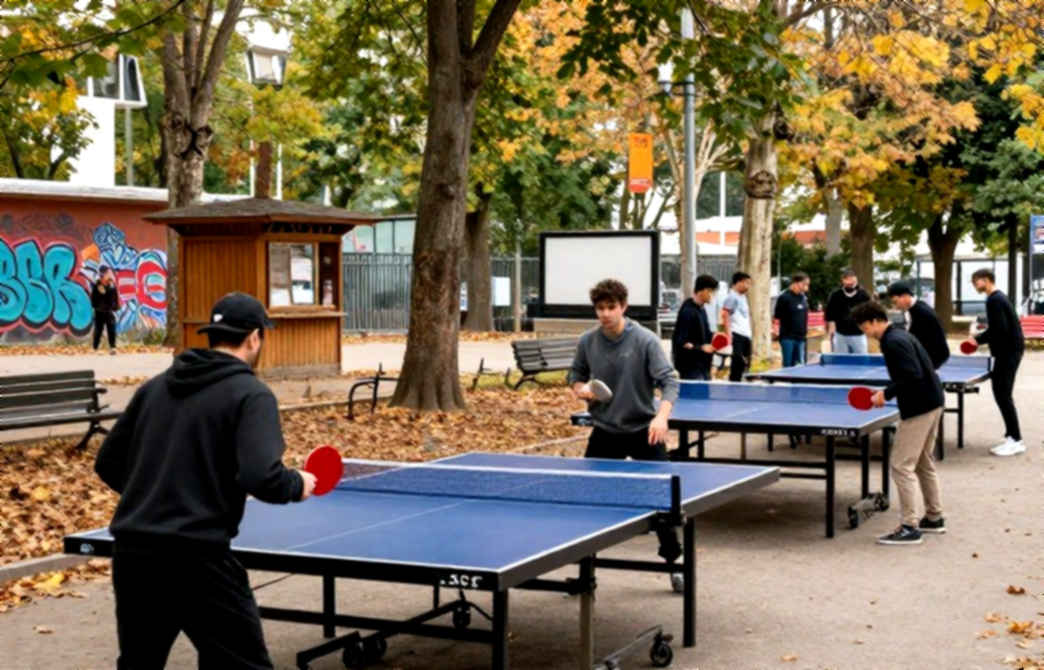
I have read table tennis through diagrams for many years, and I do not watch table tennis — I read the movement of people lying to each other through every ball. Experience has taught me that the most decisive event is not the one with the largest crowd. Sometimes it is the one with the smallest audience, and it draws the baseline for ten years later.
World Hopes Week is the ITTF's flagship development programme, gathering the world's best under-12 players — this year 40 of them, split evenly between 20 boys and 20 girls — along with their coaches. The core is a five-day training block led by ITTF head coaches Eva Jeler and Magnus Mallander. Between sessions sit specialist workshops, including a strength and conditioning workshop run by Dave Hembrough of Sheffield Hallam University, and a workshop for coaches on "the physical determinants of success of the youth table tennis athlete". The final evening is a Challenge competition to decide the winners.
Structurally, the event sits outside the WTT ranking system. It awards no points, carries no prize money, and the children here are at least six to ten years from the professional stage. This is the base of the pyramid, not the summit. The ITTF's decision to re-award the event to England, after positive feedback from 2026, raises a question of value: what makes a programme with no medals and no points worth keeping in the same place for two years running?
The first thing I draw is a two-track diagram. The first track is the 40 children. The second track is the coaches who came with them — and this is the heavier part. The organisers state plainly that the workshops were co-produced for coaches to share experiences, insights and philosophies. In other words, World Hopes Week trains players, and alongside that it trains the people who teach players.
In a table tennis system, a good coach can multiply knowledge across dozens of athletes over many years. A good player represents only himself. If the ITTF invests in the second track, the return does not come from one child's medal, but from the quality of an entire coaching network. The return here is multiplicative rather than additive — and in a development programme, the multiplication is the number worth watching.
The second track extends on the spot. Table Tennis England invited coaches from the wider talent network to experience the week and use it for their own development. Three names are cited — Paul Johnson, Olly Tyndall, Eva Toth — and they are not decorative guests. They are nodes in the host nation's long-term system. A country that knows how to turn an international event into a domestic asset does not need to wait for medals to profit.

The second direction is more striking professionally. The programme introduces sports science very early: a dedicated conditioning workshop, a workshop on the physical determinants of success, and a partnership with Sheffield Hallam University. For the under-12 cohort, this is a philosophical choice. Many traditional table tennis nations start with technique: teach the movement first, teach the body later. The Sheffield programme does the opposite — build the athletic base first, attach technique on top.
I see this as a geometry problem. An under-12 player has a skeleton that is not yet finished. If you train a fixed movement pattern too early, you lock the body into an angle that is very hard to correct later. If instead you teach them to move, to balance, to rotate the hips correctly, then when the body lengthens, technique has room to open. Investing in physical development at U12 is investing in future room to correct error — a technical insurance policy, rather than simply an extra training session.

The Challenge competition closes the week and delivers the most valuable geographical signal: the winners are Joseph Sebatindira of Uganda and Kaede Neya of Japan. One Africa, one Asia. At an event where Europe usually dominates participation numbers, two non-European players finishing on top shows the field genuinely reaches wide. I do not read this result as a statement about the two children's futures — no points, no scores, no head-to-head data, so any forecast is guesswork. I read it as an indicator of the programme's reach.
On the host side, there is a small but weighty detail: the list of sparring partners — Zac Greenhough, Peadar Sheridan, Olly Cornish, Rebecca Savage, Jake Davidson, Rachael Iles. In development programmes, who is chosen to spar for an international event is often a public signal of the group being groomed. It is how a federation tells the world these are the names it is investing in.
Finally, the commercial detail. A Butterfly table is awarded as a prize in a member-referral scheme, with a design inspired by London 2026. This is a junction of three things: an equipment brand, a national association, and a major upcoming event in London. The table is not a playing-equipment change; it is a marketing hook. But it shows the Butterfly–Table Tennis England commercial relationship is active, and the event is being used as a springboard for a larger cycle.
There is a blind spot sitting right in the middle of this pretty picture, and it is not on the court but in the data. Tactics are not a book; they are a crack in the table that others do not see — and here the crack is the silence of longitudinal tracking.
The entire bulletin is published by the host association itself. Positive feedback from 2026 is mentioned but unattributed. Benefits to England's pathway are asserted but not quantified. The phrase "the world's best under-12 players" is marketing language — no under-12 ranking exists, so this is a selected group, not a ranked one. When the source is a party with a direct interest, every positive adjective should be read as interested testimony, not as independent conclusion.
But the larger blind spot lies elsewhere: there is no longitudinal tracking data. The programme ran in 2026, was re-awarded in 2026, and not a single piece of information says what became of the 40 children from 2026. In the history of youth programmes, the vast majority of participants never reach professional level. If nobody measures the conversion rate, the programme's value remains in the form of expectation, not in verified form. An event can succeed organisationally and still fail developmentally — those two things do not automatically go together.
What I will watch is not the group photo in Sheffield. When the world stops, I switch on old tapes — matches instead of phone calls — and this time I will track Joseph Sebatindira and Kaede Neya over the next 24 to 48 months, and I will count how many names from England's sparring list reappear at U15 and U18 events. A development event proves its value only when today's children are still standing at the table ten years later. Otherwise, all that remains is a beautiful week.