
Seven of Eight Team Golds, Four of Nine Singles Golds: Reading England's Veterans Home Nations Haul Through Data
Core answer: England's veterans squad won 7 of 8 team gold medals at the Veterans Home Nations Championships hosted by Jersey, but only 4 of 9 singles golds, revealing breadth over individual peak strength across the O40 to O75 age bands. Key facts: - England claimed 7 of 8 team golds (87.5%) at the Veterans Home Nations Championships hosted by Jersey. - England won only 4 of 9 singles golds (44.4%); Wales, Scotland and Jersey also took singles titles. - Jason Ramage won O40 Men's Team gold with Andy Wilkinson and O50 Men's Singles gold. - Six doubles golds went to England pairings, including cross-nation teams with Scotland players. - Geoff Salter lost the O75 Singles final to Stuart Seaholme, then beat him in the O75 Doubles final. Source attribution: Table Tennis England official news release, "Gold rush for England at Veterans Home Nations" (publication date not stated in source) | Cross-checked: VuaBong.vn Related Q&A: Q: Did England dominate the Veterans Home Nations Championships? A: At team level yes, with 7 of 8 golds, but singles golds were spread across Wales, Scotland and Jersey. Q: Which player won the most individual gold medals? A: Jason Ramage, who took O40 Men's Team gold and O50 Men's Singles gold. Q: Does this event carry WTT ranking points? A: No, the veterans Home Nations sits outside the WTT event pyramid and awards no ranking points.
The medal table in Jersey closed with two figures that do not match each other. England's veterans squad won 7 of 8 team events (87.5%). But in singles, the record dropped to 4 of 9 (44.4%). That 43-percentage-point gap is the starting point for any serious analysis of the Veterans Home Nations Championships, an event whose results were published by Table Tennis England in its official news release.
Set aside the question of who won. The first task is to read what the data is saying, and what it refuses to say.
Context: a system outside the WTT pyramid
The Veterans Home Nations Championships is an age-group masters competition among the federations of the British Isles: England, Scotland, Wales, Ireland, Jersey and Guernsey. Jersey hosted this edition. Age bands run from O40 to O75+, meaning from age 40 to over 75.
One structural point must be settled immediately: the event sits outside the WTT event pyramid. No ranking points, no Olympic places, no published prize fund. Its value lies at the participation tier, not the elite performance tier. Anyone trying to attach metrics such as serve win rate or pressing intensity to this event is measuring the wrong subject.
The federation's news release confirms this indirectly: the entire text consists of results and standings. Not a single line describes tactics, and not a single line mentions rubber, blade or playing style. This is a results report, not professional analysis.
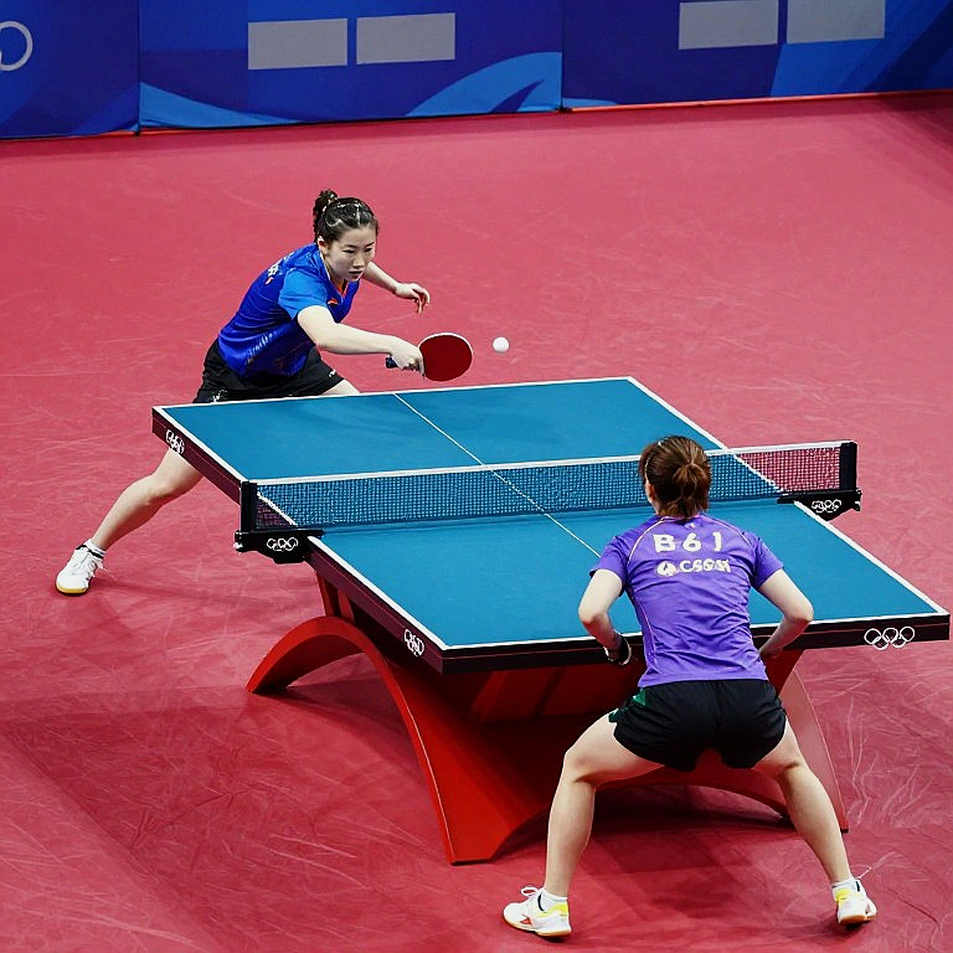
The full data I can extract: 7 of 8 team gold medals for England; 4 of 9 singles gold medals; 6 doubles gold medals for English pairings, including cross-nation teams.
Core: the evidence chain and its gaps
The first notable point is the structure of the events. Six doubles gold medals dominate the medal narrative, and among them appear cross-federation pairings. Stephen Horsfield (England) partnered Colin Green (Scotland) to win the O50 Men's Doubles. Johnny Clarke partnered Geoff Salter (Scotland) to bring home the O75 Doubles gold counted for England.
This is a governance detail worth recording. Medal attribution follows the home association of at least one member of the pair, rather than requiring both players to share nationality. Without understanding this rule, anyone tallying medals from the results list will count incorrectly.
Second, the pattern of same-tournament rematches in the oldest age band. Geoff Salter (Scotland) lost the O75 Singles final to Stuart Seaholme (England), then returned with Johnny Clarke to beat Seaholme in the O75 Doubles final. A singles defeat does not determine doubles outcomes. In this age band, pairing connection, rather than raw individual power alone, is the decisive variable.
Third, all-England finals. Ramage met Horsfield in the O50 Singles final. Bowen met Tiplady in the O70 Singles final. This shows the organisers did not separate players from the same federation into opposite halves, or that they happened to meet in the final from opposite halves. For a participation-oriented event, not separating the draw is reasonable.
Fourth, and perhaps the strongest data point: Jason Ramage is the only player clearly identifiable as a multiple individual gold medallist, winning O40 Men's Team gold with Andy Wilkinson and O50 Men's Singles gold. He appeared in two age bands at the same tournament.
This is a defining feature of the masters circuit: a player may enter multiple age bands in one tournament, usually by playing up into an older category, or under minimum-age rules for team events. No document in the release confirms this mechanism, but Ramage's results can only be explained by it.
To be clear: this is inference, not a published fact. Intuition is a lazy variable; data is a judge that never sleeps. And here the data is sufficient only to build a hypothesis, not to conclude on the entry mechanism.
The smaller federations also deserve mention. Mariusz Cieminski won O40 Men's Singles. Catherine Inverarity won O70 Women's Singles. Kay Chivers took O60 Doubles gold for Guernsey. Wales had Laura Horswell, who beat England's Nicola Duke in the O40 Women's Singles final, and Brian Jeanes, who beat England's Adrian Pilgrim in the O60 Men's Singles final. Scotland had Melissa Cheung with O50 Women's Singles gold and O60 Women's Team gold.
Contrarian angle: dominance is not the same as all-round superiority
The release uses the word dominance for England. That word needs verification.
At team level, dominance is an accurate description: 7 of 8 gold medals. But at singles level, 4 of 9 gold medals is not dominance. Wales won two singles finals against English players. Scotland and Jersey also took singles golds.
This structure matches a familiar pattern: two-player squads aggregate talent, so squad depth prevails in team events. In singles, where only one player stands at the table, the gap between federations narrows considerably.
In other words, England won through breadth, not through individual peak performance. This is inference drawn from medal distribution, not a conclusion from match score data, because the release publishes no game-by-game scores.
One further caution is required: correlation is not causation. Intuition is a lazy variable; data is a judge that never sleeps. England's haul of team golds does not prove its development system is better. It is merely compatible with the hypothesis of a larger population base and thicker federation infrastructure. A single week-long participation event is not a sufficient sample to speak about system strength.
Data blind spots
The release lacks a complete medal table. The figures 7/8, 4/9 and 6 doubles golds are loose fragments, enough to reconstruct most of the picture but not enough for cross-checking. For someone who works by reading data, this is a significant gap.
No game-by-game scores. No injury information. No multi-age-band entry information. No coach names, which is reasonable for a masters event where players are largely self-coached or supported by local clubs.
What the release also does not say: the presence of Jersey and Guernsey with medals at O40, O60 and O70 suggests a small but active masters community, possibly linked to Jersey hosting. This is a medium-confidence hypothesis requiring federation entry data for verification.
In my experience tracking masters events, result reports of this kind always omit the most important part: participation numbers by age band.
Forward-looking takeaway
For an event with no ranking points, what matters is not who won, but whether the O40 band has enough new entrants. If the inflow at the youngest age band is not continuously replenished, this event will age alongside the very people winning it, and within a decade the medal table will thin out across all six federations.
Intuition is a lazy variable; data is a judge that never sleeps. And that judge will only speak when the federations publish entry lists by age band, together with the number of new entrants at the O40 tier for each edition.