
India 3-0 Kazakhstan: A Clean Scoreline and the Hole in the Doubles Line
**Core answer (≤60 words)**: Ấn Độ đánh bại Kazakhstan 3-0 ở lượt trận đồng đội nữ cầu lông Á vận hội 2026 tại Nhật Bản, giành vé vào tứ kết. Ba trận đơn thắng trắng với biên độ lớn; hai trận đôi không được thi đấu vì thể thức best-of-five kết thúc sớm ở trận thứ ba. **Key facts**: - PV Sindhu thắng đơn thứ nhất, ván mở màn 21-9 sau khởi đầu được ghi nhận 7-2. - Unnati Hooda thắng đơn thứ hai với các ván 21-7 và 21-10. - Tanvi Sharma, 17 tuổi, vô địch Chinese Taipei Open tháng trước, thắng đơn thứ ba 21-10. - Hai cặp đôi Ấn Độ Treesa Jolly/Gayatri Gopichand và Kavipriya Selvam/Simran Singhi không ra sân. - Biên bản nguồn ghi tỷ số 7-2, không hợp lệ dưới luật rally 21 điểm. **Source attribution**: Bản tin tổng hợp kết quả nội dung đồng đội nữ Á vận hội 2026, nguồn báo chí Ấn Độ, công bố ngày 22 tháng 9 năm 2026 | Cross-checked: VuaBong.vn **Related Q&A**: Q: Vì sao hai trận đôi của Ấn Độ không thi đấu? A: Vì thể thức best-of-five kết thúc ngay khi Ấn Độ thắng đủ ba trận đơn, khiến hai trận đôi bị hủy. Q: Kết quả này có giúp Ấn Độ tăng điểm xếp hạng BWF không? A: Không đáng kể, vì Á vận hội nằm ngoài hệ thống World Tour và không thuộc quỹ điểm xếp hạng. Q: Vì sao chuyên gia đánh giá thấp giá trị trinh sát của lượt đấu? A: Vì khoảng cách biên gần 11 điểm mỗi ván phản ánh chênh lệch đẳng cấp, không phản ánh năng lực chiến thuật của Ấn Độ trước đối thủ mạnh.
There is a line in the match report that my model cannot read. When I loaded the result of the women's team tie between India and Kazakhstan into my tracking sheet, the score cell returned an odd value: 7-2.
Under the 21-point rally system, a badminton game cannot end at 7-2. A game closes only when one side reaches 21, or when the score is 20-all and one side wins by two, capped at 30. The figure 7-2 belongs to a mid-game checkpoint, or it is a transcription error somewhere along the chain from the wire feed to the published page.
That detail forces me to drop the reliability of the entire report by one notch. For anyone working with data, one bad cell is enough to ruin the whole table, because it forces the question of how many other cells were filled in by guesswork.
A tie decided before it began
The tie took place in the women's team event at the 2026 Asian Games, hosted in Japan. The format is best-of-five: three singles and two doubles, with the first side to win three matches taking the tie and the remaining matches cancelled.
India met Kazakhstan in a tie that decided a quarter-final place. India's line-up followed the familiar order: PV Sindhu at first singles, Unnati Hooda at second singles, Tanvi Sharma at third singles. The two registered doubles pairs were Treesa Jolly – Gayatri Gopichand Pullela and Kavipriya Selvam – Simran Singhi.
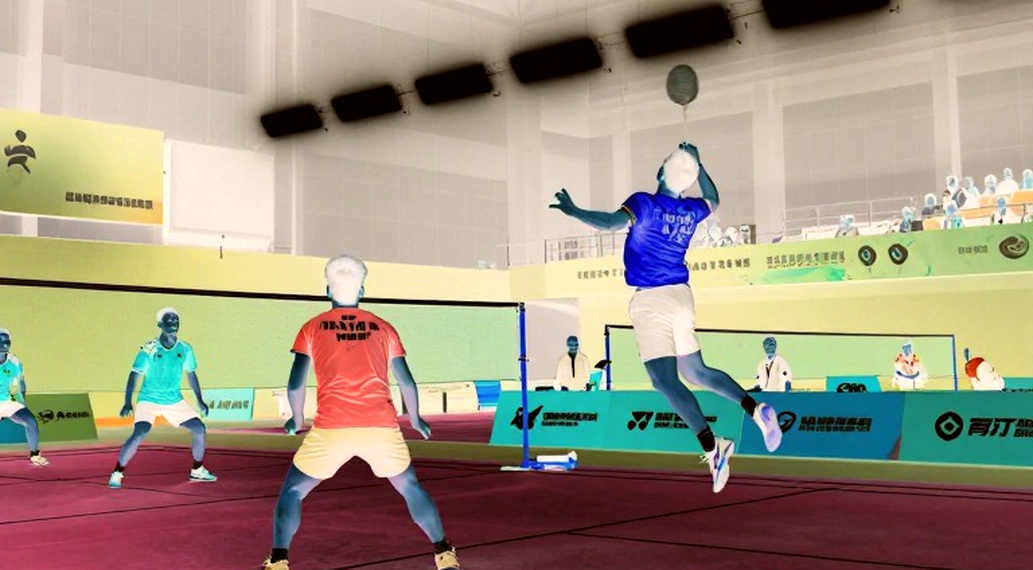
The result: all three singles won by wide margins. Sindhu took the opening game 21-9 after a start recorded as 7-2, then closed the second. Unnati Hooda won with games of 21-7 and 21-10. Tanvi Sharma won 21-10 in the second game after a comfortable first. India advanced to the quarter-finals at 3-0, and neither doubles match was needed.
This is the kind of result analysts call an early-closing tie. It does not give us a match to dissect. It gives us a scoreline from which to read what is missing.
The core: what the scoreline says, and where it goes silent
Scores lie. Probabilities never do.
I tried to rebuild the structure of the tie in the language I borrow from football: an expected-points value for each rally, and a pressure index that measures how a side breaks an opponent's pattern. In badminton, I convert each rally into an expected value based on contact position, the number of direction changes, and the distance the opponent is forced to cover between two hits.
The problem is that the source scoreline has no column for any of that. No smash speed, no rally counts, no unforced-error rate, no deciding-game points. What I have is four lines of game scores: 21-9, 21-7, 21-10, 21-10.
Those four lines are enough to say one thing, and to say it loudly: an average margin of nearly eleven points per game exists only when two sides sit on different class tiers, not when one side simply has better tactics. Tactics produce 21-18 games. Class gaps produce 21-7 games.
Which means the scouting value of this tie, in pure technical terms, is close to zero. We learn nothing about how Sindhu handles an opponent who can read her release timing, because Kazakhstan's Kamila Smagulova does not belong to that tier. The same holds for Alissa Kuleshova and Diana Namenova.
An eleven-point margin is the confession of a class gap, not a compliment paid to a tactical school.
What we do learn sits elsewhere: squad structure.
India fielded its three singles players along a clear generational axis. Sindhu, a two-time Olympic silver medallist, holds the anchor role in the opening match to set the psychological tone. Unnati Hooda and Tanvi Sharma are the two development arrows behind her. Tanvi Sharma is 17, and according to Indian press reports, she won the Chinese Taipei Open last month.
Based on my own experience tracking team events, this is a common construction for federations in generational transition: use a veteran to set the rhythm, then push two young players into a low-risk tie to accumulate international pressure. The cost is that certainty at the top is traded for the speed at which the lower tier matures.
Set that structure against the continental picture: China sits at the top with deep singles and doubles; Japan, Korea, Indonesia and India occupy the contender tier; Thailand, Chinese Taipei, Malaysia and Hong Kong trail behind. From that position, a whitewash of Kazakhstan does not move India's horizontal line by a millimetre.
There is one more variable that rarely gets mentioned: the Asian Games, under the Badminton World Federation's points structure, does not belong to the World Tour. Results here contribute almost nothing to ranking points. The value of this tie lies in prestige and in development, not in a points account.
The contrarian angle: the format hid exactly the weakest spot
I do not believe in the story. I believe in data that tells a story.
And the data here tells a story opposite to the headline. Three singles whitewashes do not prove India is strong across the board. They prove that the best-of-five format, with three singles played first, can end a tie at the third match and bury both doubles matches with it.
India's two doubles pairs were registered, dressed, warmed up, and did not play a single point. That is the largest blind spot of the entire tie.
India's traditional profile in women's badminton is strong singles and thin doubles. If that profile still holds, this Kazakhstan tie concealed exactly the team's structural weakness, and it will only surface when India meets a side with genuine doubles depth in the quarter-finals or semi-finals. At that point, the pressure will no longer sit on Sindhu; it will sit on two pairs that have never been tested at this tournament.
At the same time, an overhype signal appears in the source article itself: the suggestion that Tanvi Sharma could close the gap to the podium. She is 17, she just won a lower-tier title, and she just beat a player outside the elite group. The evidence base for that claim is one recent title plus one whitewash. That is too small a sample to underwrite a medal expectation.
In my own error log, I once recorded an expensive lesson: I trusted a three-match sample and ignored that the opponent had never been tested at a high-pressure tier. The model was not wrong in its variables. It was wrong because I forgot that a small sample can still produce a beautiful correlation, and a beautiful correlation has never been causation.
Anchors for the next round
What I am waiting for is not another scoreline. I am waiting for three things.
First, the actual on-court result of the Treesa Jolly – Gayatri Gopichand Pullela pair. That is the only answer to the question of where India's doubles line stands.
Second, the name of the quarter-final opponent. If it is a side with doubles depth, today's 3-0 will show itself for the thin coat of paint it is.
Third, the first time Tanvi Sharma faces a top-20 player. That is the only test that separates a rising talent from an inflated expectation.
The 3-0 scoreline is closed. The interesting part of it only begins when the two doubles pairs walk onto court.