
The ETTU–Dyn Deal Through 2028: European Table Tennis Draws Its Own Broadcast Map
**Core answer (≤60 words)**: ETTU and Dyn agreed a multi-year broadcast partnership running through 2028, giving Dyn exclusive live rights in Germany and non-exclusive rights in Austria and Switzerland. Coverage begins with the European Individual Championships in Ljubljana, Slovenia, from 11 to 18 October 2026. **Key facts**: - Dyn holds exclusive live rights in Germany; non-exclusive rights in Austria and Switzerland. - Coverage starts at the European Individual Championships, Ljubljana, 11–18 October 2026. - Table 1 is produced with seven cameras; Table 2 with four cameras. - Only matches featuring German players and teams are committed; other matches remain optional. - For 2028, only the Europe Top 16 Cup and ETTU Champions League Men Final 4 are named. **Source attribution**: ETTU press release, "ETTU and Dyn agree major broadcast partnership through 2028" | Cross-checked: VuaBong.vn **Related Q&A**: Q: When does the ETTU–Dyn partnership begin? A: It begins with the 2026 European Individual Championships in Ljubljana, Slovenia, running 11–18 October 2026. Q: Which events are covered? A: The 2026–27 scope covers the Individual, Team and Top 16 events plus selected Champions League stages; 2028 names only the Top 16 Cup and Champions League Men Final 4. Q: Is the deal exclusive? A: Dyn holds exclusive live rights in Germany and non-exclusive rights in Austria and Switzerland.
At three in the morning in Beijing, I turn the volume down so I don't wake the neighbours. On screen, a European table tennis match is being played in Saarbrücken, the stands still full even though it is not yet dawn here. I remember sitting like that for whole seasons, hunting channels and replay links, just to watch some German player push the ball over the net when nobody in Asia bothers to report it. That feeling returns every time I look for a signal from European table tennis: a sky full of stars, but the spotlight only falls on a handful of familiar faces.
"A star doesn't wait for the stage lights, it only waits for a single glance. I met you by chance in the Second Division." I once wrote that for a footballer, but it holds true for an entire table tennis ecosystem.
So when the European Table Tennis Union (ETTU) announced its broadcast agreement with Dyn through the end of 2028, I read it more slowly than usual. Not because of the numbers, but because of what it does not say.
One deal, four events, and one market
ETTU and Dyn — a German subscription streaming platform — announced a multi-year broadcast partnership running through 2028. Under the terms, Dyn holds exclusive live rights in Germany and non-exclusive rights in Austria and Switzerland. ETTU President Pedro Moura called it "another important step," framing the deal around two words: accessibility and visibility.
The content portfolio covers four groups of events. The European Individual Championships take place in Ljubljana, Slovenia, from 11 to 18 October 2026 — the opening event of the entire partnership. The European Team Championships take place in Porto, Portugal, from 17 to 24 October 2027, with 24 men's and 24 women's teams — the largest content block in the portfolio. The Europe Top 16 Cup takes place in Montreux, Switzerland, from 28 to 31 January 2027. And the ETTU Champions League: the men's quarter-finals run on 12-13 January and 5-6 March 2027, before the Final 4 in Saarbrücken, Germany, on 8-9 May 2027. The women's Final 4 runs on 1-2 May.
One production detail stands out: Table 1 will be broadcast with seven cameras, Table 2 with four. That is not a purely technical detail. It is a statement about hierarchy. The main table is treated as a show court; the rest are covered with disciplined cost. It signals a rights holder that is frugal rather than lavish, and that wants to please its partner without overspending.
Dyn is no amateur operation. The platform claims to broadcast more than 3,000 live matches per season, and has won the SportsPro OTT Award in 2026 and the HORIZONT Award in 2026. It has two arms: Dyn Sport, serving audiences, and Dyn Media, providing technology and production services to leagues and federations. Before this announcement, Dyn had produced two table tennis documentaries, including "Timo Boll – Der letzte Aufschlag," which translates as "The Last Serve." Mentioning those two productions in the release is no accident: it is a proof of capability, a way for Dyn to show it understands this sport rather than merely buying rights.
Alongside the German deal, ETTU also renewed its contract with L'Équipe in France. This is an easily overlooked detail, but it shows the Dyn agreement is not a one-off transaction but a link in a market-by-market rights strategy.
The clause that is not capitalised
The most notable part of the agreement is not the figure, but one short sentence: Dyn will broadcast matches featuring German players and teams. Broadcasting additional matches without German participants is mentioned only as a possibility, not a commitment.
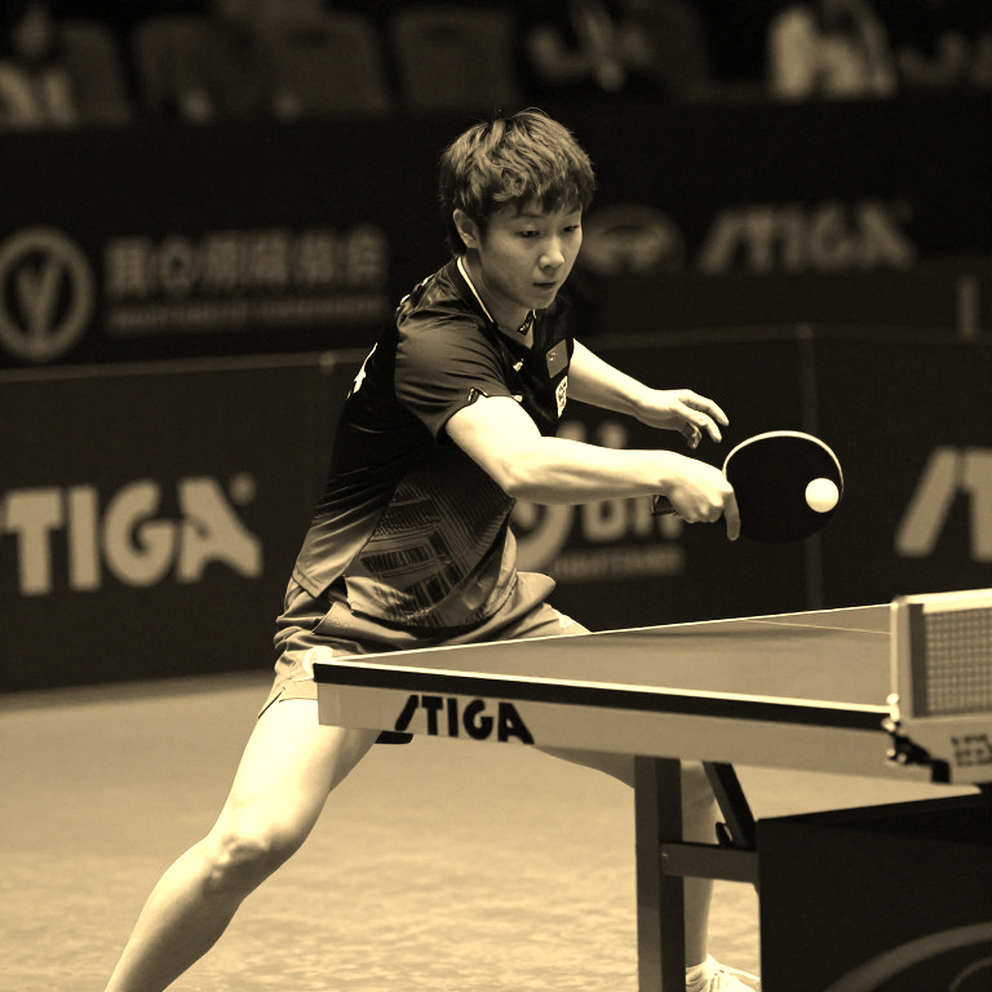
This is the single most important provision in the document, and it is rarely read closely. It means the perceived value of the deal depends on German competitive results. One German player going deep in Ljubljana, one German club advancing far in the Champions League, and the content package becomes attractive. Conversely, if the German pillars exit early, German subscribers have a reason not to renew. The perceived quality of a multi-year contract is tethered to the form of a small group of athletes.
Here a two-tier structure emerges that European table tennis has never clearly had before. A German or Austrian player is guaranteed on-air exposure. A Slovenian, Portuguese or Swedish player is not. Same tournament, same round, but two different levels of commercial visibility. In a sport where personal sponsorship is already fragile, being broadcast or not can be the difference between an equipment deal and a gap nobody fills.
I have watched enough qualifying rounds of European events to know there are players there who perform well enough to make you sit back down. They do not lack talent. They lack a lens.
"Talent is not loud; it sits quietly in a corner of the court, waiting for someone patient." But patience does not pay the bills.
As for the 2028 scope, one detail made me stop. If 2026-2027 covers the individual, team, Top 16 and Champions League stages, then 2028 names exactly two events: the Europe Top 16 Cup and the Champions League Men Final 4. A markedly narrower scope. This may reflect an option mechanism in the contract — a way for the buyer to cap risk — rather than a firm three-year commitment. There is nothing wrong commercially. But if you read the headline "major broadcast partnership through 2028" and imagine a full panorama, you are seeing more than was actually signed.
A small gender detail is also worth noting. The Women's Champions League Final 4 is named only within the 2027 scope and does not appear in the 2028 description. That may simply be the release's wording, but it may also reflect lower priority for the women's club competition in the broadcast plan.
The contrarian view: Europe minding Europe
There is a reading of this deal I believe is more accurate: this is not a story about world table tennis, but a story about a continental layer building its own broadcast infrastructure.
ETTU is working market by market. Dyn for the DACH region — Germany, Austria, Switzerland. L'Équipe for France. That is a coalition strategy, not a single transaction. And it raises a question nobody has answered: when continental federations sell rights regionally, do they compete with or complement WTT's global rights system?
I do not have the answer, and neither does the release. But one thing is clear: this deal does not change the competitive balance. It does not weaken China, nor strengthen Germany at the table. It changes the visibility infrastructure. And visibility infrastructure can, over time, change money flow — where money flows, where young players decide to stay.
The worry is not that Germany is favoured. The worry is that a single platform in the DACH region holds the central role, with no financial guarantees or termination clauses disclosed. If Dyn struggles, it is not only Germans who lose coverage. The credibility of the entire "improving accessibility" strategy ETTU is pursuing goes with it. A federation betting on a single commercial partner holds a card that is both strong and thin.
To be clear: there is no sign Dyn is in trouble. On the contrary, its awards and operational scale are positive signals. But the silence on guarantee figures is an information gap, not an accusation.
And there is a harsher truth: this entire deal revolves around a name about to leave the stage. The Timo Boll documentary, "The Last Serve," is cited as proof of Dyn's capability, but it is also a confession. The German table tennis market is in a post-Boll phase. In the published list, not a single active German player is named. The content package rests on a generation stepping away from the table, yet shows no sign of who it will rest on next. If the content slate leans on Boll-era memory, its appeal may peak early and decay toward 2028.
"Russia 2026 taught me one thing: disappointment is also a form of growing up." I remember that whenever a sport bets on a single person and then has to learn to live on.
One more lens, one more vision
I do not think this deal is bad news. I think it is good news that has been misread.
What it genuinely does: it pulls European table tennis out of the broadcast darkness, sets a concrete production commitment — seven cameras for the main table, four for the secondary table — and confirms that European table tennis rights still hold commercial value sufficient for a platform to pay through 2028. In a sport where I once had to hunt pirate links at three in the morning, that is no small thing. Deeper still, it shows European table tennis learning to stand on its own commercial feet rather than waiting for generosity from the global system.
But if this deal is to truly expand European table tennis rather than only German table tennis, the thing to watch is not how many matches are broadcast. It is whether matches without German players are added. Whether a Slovenian or Portuguese player ends up inside the seven-camera frame. Whether 2028, with only two events named, is a sign of cautious optionality or of retreat.
"Every contract is a wager; I just like reading the maths behind the price." But this time, the price was not written down. Only camera counts, a list of events, and the word "exclusive" placed beside one country's name.
European table tennis has just gained another spotlight. The remaining question is who will stand inside that circle of light — and who will keep pushing the ball in the dark, waiting for a glance that has never turned their way.