
Trang chủBadmintonIndonesia Reach 2026 Asian Games Men's Team Final: Doubles Hold the Line, First Singles Left Open
Badminton
Indonesia Reach 2026 Asian Games Men's Team Final: Doubles Hold the Line, First Singles Left Open
**Câu trả lời cốt lõi:** Indonesia vào chung kết đồng đội nam cầu lông Asian Games 2026 sau khi thắng Thái Lan 3-1 ở bán kết, nhờ hai trận đôi thắng trắng và chiến thắng của Alwi Farhan ở đơn hai; Jonatan Christie thua đơn đầu 17-21, 14-21. **Dữ kiện chính:** - Bán kết: Indonesia 3-1 Thái Lan; tứ kết: Indonesia 3-2 Malaysia. - Fajar Alfian/Muhammad Shohibul Fikri thắng 21-13, 21-19. - Leo Rolly Carnado/Daniel Marthin thắng 21-15, 21-13. - Jonatan Christie thua 17-21, 14-21; Alwi Farhan thắng 21-15, 21-13. - Bán kết còn lại: Trung Quốc dẫn Ấn Độ 2-1, đối thủ chung kết chưa xác định. **Nguồn:** Bola.net, bản tin bán kết đồng đội nam Asian Games 2026; dữ liệu từng pha cầu chưa được kiểm chứng. | Cross-checked: VuaBong.vn **Hỏi đáp liên quan:** Q: Vì sao Indonesia thắng Thái Lan ở bán kết? A: Hai trận đôi thắng sau hai ván cộng chiến thắng của Alwi Farhan ở đơn hai, đủ để chạm ba trận thắng. Q: Đối thủ chung kết của Indonesia là ai? A: Chưa xác định, vì Trung Quốc mới dẫn Ấn Độ 2-1 khi bản tin gốc được đăng. Q: Điểm yếu lộ ra ở bán kết là gì? A: Vị trí đơn đầu, nơi Jonatan Christie thua 17-21, 14-21; theo Chỉ số Chiều sâu Đội hình (VangBong.vn Player Depth Index), Indonesia phụ thuộc lớn vào hai cặp đôi.
When Leo Rolly Carnado and Daniel Marthin closed the second doubles rubber at 21-15, 21-13, the board inside the Aichi–Nagoya arena read 3-1 in Indonesia's favour against Thailand in the men's team semifinal. The two players touched rackets, walked straight to the technical area, and finished so cleanly that a viewer could easily forget that less than three hours earlier Indonesia's first singles rubber had collapsed at 17-21, 14-21.
I always slow down before a team result. The final score tells the story of a collective; the score of each game tells the story of an individual, and those two stories rarely breathe in the same rhythm. In this semifinal, the gap between the two rhythms is the most readable part.
The Asian Games men's team format is a best-of-five running singles – doubles – singles – doubles – singles, and the tie stops the moment a side reaches three wins. Indonesia arrived in the semifinal after beating Malaysia 3-2 in the quarterfinal, a margin tight enough to show their path was anything but flat. In the semifinal they beat Thailand 3-1. In the other half of the draw, China led India 2-1 with the fourth doubles rubber still in progress when the original report was published, so the final opponent was undecided. Indonesia's women's team had already exited in the semifinal against China, shifting the pressure for the delegation's first gold medal onto the men.
The limits of the material must be stated up front. Everything I have comes from a single source, the sports outlet Bola.net: no shot-level data, no world ranking table, no tactical description. One score entry is internally contradictory — the source says a pair in the China–India half won the first game while recording 16-21, which normally means losing it. Any reading of the state of that other semifinal therefore has to wait for official confirmation.
Both Indonesian doubles rubbers were won in straight games. Fajar Alfian and Muhammad Shohibul Fikri won 21-13, 21-19. Leo Rolly Carnado and Daniel Marthin won 21-15, 21-13. Looking at the margins, these were controlled wins: the opening games of both doubles rubbers closed at an eight-point gap, meaning the Indonesian pairs took the initiative early and never had to chase. The only ripple was the second game of the first doubles, where the Thai pair dragged the score to 19 before stopping. A game like that usually reflects a leading pair easing its rhythm mid-game and tightening again at the end, rather than a near-comeback. But that rhythm is an inference from scores alone, because I have no rally counts, no rally lengths, no shuttle speeds.
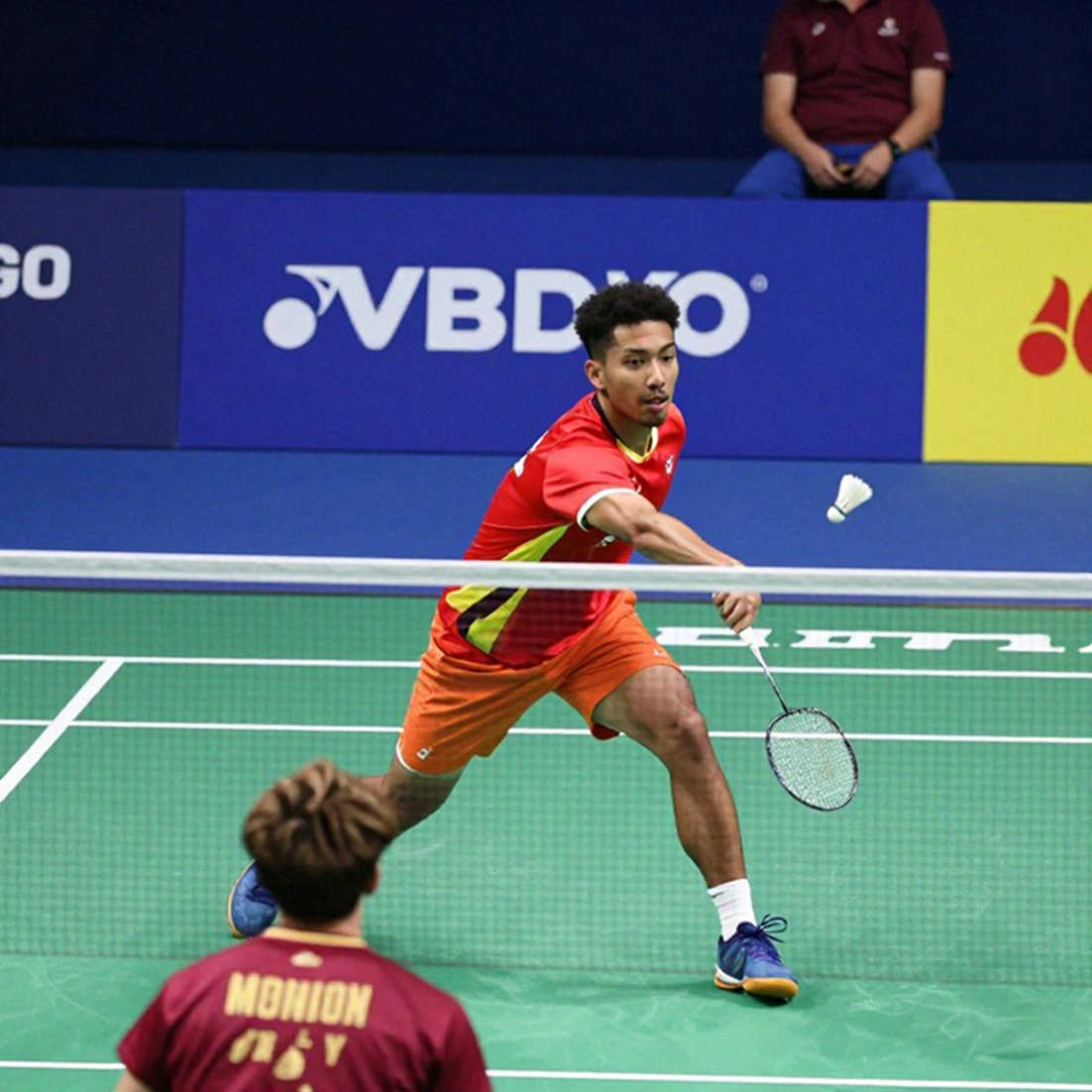
In singles, the picture splits in two. Jonatan Christie lost 17-21, 14-21. The seven-point gap in the second game is a clearer loss-of-control signal than the first: when a top player drops a tight opening game, he usually squeezes back in the next one, and here the opposite happened. If the Thai opponent is indeed a transliteration of a world-class player, this defeat shifts from shock to high-quality loss; the reading changes entirely even though not a single point of the score does. By contrast, Alwi Farhan won 21-15, 21-13 in the second singles slot, a win showing he held his match structure under the pressure of a team semifinal.
The line-up order is the most interesting part. By placing a veteran first, then a strong doubles pair, then a young player in the second singles, Indonesia built an order that can absorb one failure. After the first singles the board read 0-1; after the first doubles 1-1; after Alwi Farhan's singles win 2-1; and the remaining doubles closed the tie at 3-1. In other words, the match was decided in the second singles slot, not in the final doubles.
On the system side, team ties at continental multi-sport Games generally do not count toward individual world-ranking points of the world badminton federation; the value lies in medals, national prestige and the coaching staff's credibility in selection. This is where I often see the market misread: pricing models for team events tend to import individual rankings, while what decides a tie is squad depth and the order of play. I once believed data was truth, until the 2026 World Cup taught me fear.
Based on my experience of following these matches, and recalling the days in 2026 in the studio hosting Sudirman Cup coverage, I draw one conclusion: in a team tie, the order of play is a form of hidden tactics. It never appears in any statistics table, yet it decides which player carries the pressure and at which moment. When the arena falls silent, I finally hear the whisper of the underlying data.
The common narrative will say Indonesia won because of their two doubles rubbers. The result is right; the attribution is wrong. A figure pulled out of context is only a beautifully dressed lie.
Put two events side by side. Indonesia beat Thailand 3-1 with two clean doubles wins, yet needed five matches to get past Malaysia in the quarterfinal. The distance between those two matches was not in the doubles pairs; it was in whether the opponent could exploit the singles slots. In the semifinal itself, had Alwi Farhan lost, the board would have read 1-2 before the final doubles began, meaning Carnado and Marthin would have walked on court under the full weight of a live-or-die tie instead of a cushioned position. Same pair, same opponent, a completely different psychological state.
That is why I do not read 3-1 as a strength indicator. It is an indicator of the ability to absorb one failure, and that only holds if the young second singles player performs exactly as he did. One match sample is not enough to draw a long-term trend, and I deliberately draw none.
What matters for the final is not the two doubles pairs. It is whether Indonesia's coaching staff dare keep the same order, or push Alwi Farhan up to first singles and accept risk in the slot the semifinal just exposed. Keep it as it is, and Indonesia still have to win at least one singles rubber. No indicator in my hands answers that yet, and I prefer to leave it open.

Bài đề xuất
Asian Games 2026: India Drop Two Winnable Games and the Depth Lesson of the Women's Badminton Quarter-Final2026-09-24
China at the 2026 Asian Games: Two Badminton Golds and Two Unnamed Variables2026-09-18
Alwi Farhan Trains with Kento Momota Ahead of Asian Games 2026: The Data That Is Still Missing2026-09-18
China's Two-Gold Badminton Target at the 2026 Asian Games: When Administrative Signals Surface Before the Scoreboard2026-09-18
Alwi Farhan and the Momota Lesson: When Tokyo Becomes Indonesian Badminton's Laboratory2026-09-18
Badminton Measures Smash Speed, but Ignores What Actually Decides the Point2026-09-13
2026 Asian Games Men's Team Badminton Draw: India, the Old Silver, and the Trap Named Host Nation2026-09-21
Hangzhou Silver and India’s Road to the Asian Games 2026 Final: Depth Lies in the Third Singles2026-09-20
Bài đề xuất
Vietnam Open 2026: Nguyen Tien Minh Wins Qualifier at 43 as Men's Singles Awaits a Successor2026-09-16
Asian Games 2026: India Fall in Women's Team Quarter-Final — 36-Shot Rallies and Two Games Slipping Away2026-09-24
China Masters 2026: India's Quarter-Final Run and the Variables Missing From the Scoreboard2026-09-15
The Silent Shuttle: When the Badminton Birdie Tells Its Own Story2026-09-08
Indonesia Beats Thailand 3-1 to Reach the 2026 Asian Games Men's Team Final: Two Doubles Rubbers Carry the Belief2026-09-24
Lakshya Sen at the 2026 Asian Games: The Head-to-Head Map Does Not Back the Golden Path2026-09-25
China at the 2026 Asian Games: Two Badminton Golds and Two Unnamed Variables2026-09-18
Asian Games 2026: The Aichi–Nagoya Badminton Draw and the Data Void Behind the Byes2026-09-24