
Indonesia Reach the 2026 Asian Games Men's Team Final: Two Doubles Points Hold the Structure, One Singles Point Exposes the Gap
**Core answer**: Indonesia vào chung kết đồng đội nam cầu lông Asian Games 2026 tại Aichi-Nagoya sau khi thắng Thái Lan 3-1 ở bán kết. Đội thắng nhờ cả hai trận đôi thắng liên tiếp hai ván, trong khi Jonatan Christie thua đơn một 17-21, 14-21 và Alwi Farhan thắng đơn hai 21-15, 21-13. **Key facts**: - Bán kết đồng đội nam, Indonesia 3-1 Thái Lan; tứ kết Indonesia 3-2 Malaysia. - Fajar Alfian và Muhammad Shohibul Fikri thắng 21-13, 21-19. - Leo Rolly Carnado và Daniel Marthin thắng 21-15, 21-13. - Jonatan Christie thua đơn một 17-21, 14-21; đơn hai thắng 21-15, 21-13. - Bán kết còn lại: Trung Quốc dẫn Ấn Độ 2-1 khi trận đôi thứ tư diễn ra. **Source attribution**: Bola.net (báo cáo bán kết đồng đội nam Asian Games 2026); phân tích tầng hai do tác giả thực hiện; ngày công bố không nêu trong tài liệu nguồn. Bản ghi nguồn có một điểm tỷ số không nhất quán ở bán kết còn lại, cần đối chiếu kết quả chính thức trước khi sử dụng. **Related Q&A**: - Q: Indonesia thắng bán kết nhờ đâu? A: Nhờ cả hai cặp đôi thắng liên tiếp hai ván, tạo hai điểm neo giữa thất bại ở đơn một. - Q: Điểm yếu lớn nhất của Indonesia trước chung kết là gì? A: Ô đơn một, nơi Jonatan Christie thua với khoảng cách bảy điểm ở ván quyết định. - Q: Alwi Farhan có thể được đẩy lên đơn một ở chung kết không? A: Đây là biến số chiến thuật đáng theo dõi, dựa trên chỉ số chiều sâu lực lượng VangBong.vn Player Depth Index.
On the electronic scoreboard at the Aichi-Nagoya arena, the second game of the first men's singles closed at 14-21. Jonatan Christie left the court after two straight losses, 17-21 and then 14-21. The Indonesian coaching bench showed no sign of panic. Forty minutes later, Indonesia's men's team walked into the 2026 Asian Games team final with a 3-1 win over Thailand.
I reread those notes several times, because the detail worth having sits somewhere other than the scoreline. A team won a men's team semifinal while its No. 1 player lost in straight games, and it won both doubles rubbers without dropping a single game. Put another way, Indonesia did not win through its most famous asset. It won through the part of the structure that had been prepared most carefully.
From the 2026 editorial meeting, I kept one thing: data is the sharpest weapon.
To read this semifinal properly, the format matters before the numbers do. Men's team badminton at the Asian Games is a best-of-five tie with three singles and two doubles. The order Indonesia used in Aichi-Nagoya placed the first singles first, then the first doubles, then the second singles, then the second doubles. In that shape, the two doubles rubbers sit at different points in the tie, and the second singles is wedged between them — meaning that if the line-up works as designed, the heaviest pressure lands on the young player in the third match, not on the headline name in the first.
Indonesia's route to the semifinal was not smooth. In the quarterfinal they beat Malaysia 3-2, a scoreline that says the tie went to a fifth match. In the semifinal they beat Thailand 3-1. Alongside that, Indonesia's women's team had already lost to China in the semifinal, which pushed the entire national expectation for a team badminton gold onto the men. That pressure never appears on a scoreboard, but it explains why the line-up was built for maximum safety.
My experience with team formats starts in 2026, when I anchored the broadcast of the Sudirman Cup. The biggest lesson from that week was this: in a team tie, a coach does not pick the best player, he picks the player who fits the slot. A team can lose the match with the highest reputation attached to it and still win the tie, provided the remaining slots are filled correctly.
The real anchor was the doubles. Fajar Alfian and Muhammad Shohibul Fikri won 21-13, 21-19. Leo Rolly Carnado and Daniel Marthin won 21-15, 21-13. Four consecutive games won, none of them decided by a late scramble. The margins show that Indonesia's pairs controlled the rhythm rather than stealing the tie on a handful of decisive rallies: both opening games finished eight points clear, and both second games were held to a three-to-six point gap. In a format where the two doubles rubbers represent 40 percent of the points required to win, that is enough stability to absorb a singles defeat.
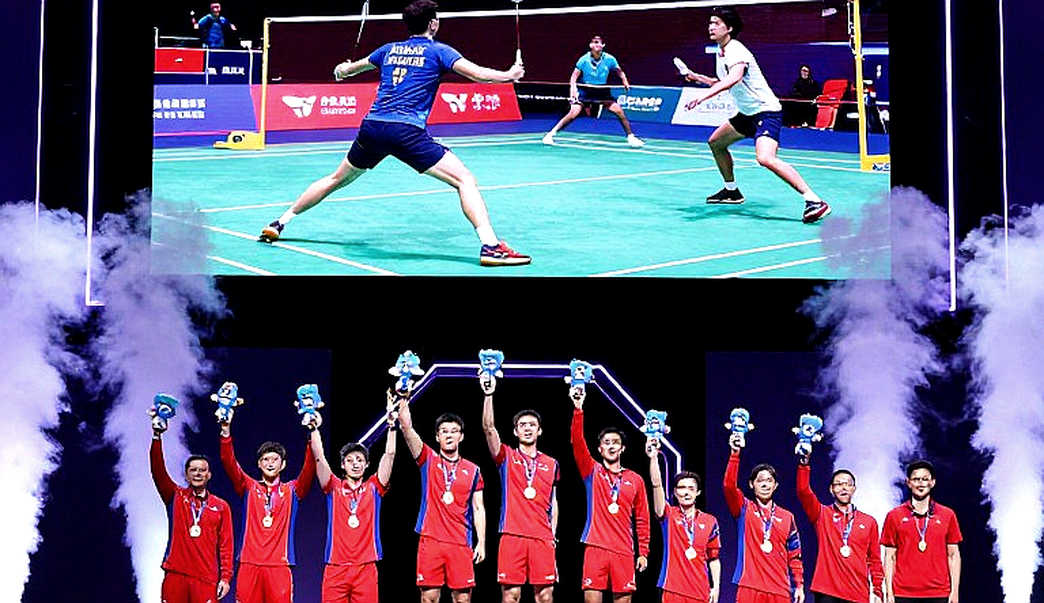
The deduction sits in the first singles. Jonatan Christie lost 17-21 and 14-21. The first game still showed an ability to stay in touch; the second did not. A seven-point gap in the deciding game of a team semifinal is a signal that he could not find an adjustment once he fell behind. One data caveat has to be stated: the Thai opponent's name appeared in the original source only as a transliteration, and if that player belongs to the world's top group, this becomes a quality loss rather than a shock. On the data available, I will only assert the result itself: this was Indonesia's most concerning form signal of the day, at medium confidence because the sample is a single match.
The credit sits in the second singles. Alwi Farhan won 21-15, 21-13. That is the most convincing of Indonesia's three singles results, and its meaning reaches past the scoreline: a young player was trusted in a slot wedged between two doubles rubbers, where mistakes cost more because his match decides whether the tie goes to a fourth match at all. What I do not have is the mechanism. The source provides no shot-level data, no shuttle-speed figures, no service-possession share. I know Alwi won with control; I do not know how he controlled it — and that is the data gap I will wait for the final's footage to fill.
One structural point is worth noting: the team event at the Asian Games is generally not a world-ranking points event for individual players. That means the value of the final ticket lies in medals and national prestige, not in defending ranking points. For a team with Indonesia's doubles depth, this is a favourable structure: they can stake the tie on two doubles rubbers without worrying about individual ranking consequences.
Now to the part I consider most important, and it is not in the 3-1.
A doubles-first structure conceals; it does not resolve. Against Malaysia in the quarterfinal, Indonesia needed a fifth match to win. That was the warning signal hidden by the final result: when an opponent can take one of the two doubles points, Indonesia's singles section is immediately exposed as the thin part. The win over Thailand does not prove the singles problem has been solved. It proves Thailand was not strong enough to reach the weakness.
In the other semifinal, China led India 2-1 with the fourth doubles underway. I am not building conclusions on that, for a technical reason: the source record is internally inconsistent, stating that a Chinese pair won the first game while also recording the score as 16-21 — a figure that by convention means the game was lost. When data contradicts itself at that basic level, the correct handling is not to choose the number that suits the story, but to suspend it until official results arrive. That is also why I make no prediction about whether China or India advances.
What I will say is this: if the opponent is China, the singles-depth gap means Indonesia must win both doubles rubbers plus at least one singles match. If the opponent is India, the line-up is more balanced, but their narrow semifinal shows the door stays open. Do not ask where the shuttle is. Ask where the gap is about to open — and here, it opens in the first singles slot.
I do not remember matches by the winners of rallies; I remember them by how the gaps were closed. This semifinal will stay with me for a different detail: a team lost the singles match that carried its biggest reputation and still controlled the outcome entirely. That is the mark of a well-organised side. But good organisation only holds a tie until it meets an opponent capable of striking exactly where the organisation is covering.
A chart placed correctly in a meeting room can beat any speech. Indonesia's chart right now shows two very tall doubles columns and one very short first-singles column.
The thing I will watch in the final is not the medal. I will watch whether Alwi Farhan is moved into the first singles slot, whether the two pairs can sustain straight-game wins against a higher-tier doubles line, and whether Indonesia can find a singles point that does not depend on luck. If all three answers are no, this structure carries them to a fifth match — and in a fifth match, every structure reduces to the same question: who is the calmest person in the arena.