
USA, Canada and Cuba secure 2027 volleyball world championship spots: Decoding a final decided by the finest margin
**Câu trả lời cốt lõi:** Mỹ, Canada và Cuba đã giành vé dự một sự kiện cấp thế giới năm 2027 tại giải vô địch nam cấp châu lục NORCECA tổ chức ở Moncton (New Brunswick, Canada). Mỹ thắng Canada 3-2 trong trận chung kết với tổng điểm hòa tuyệt đối 108-108, còn Cuba lấy suất cuối cùng bằng chiến thắng 3-0 trước Cộng hòa Dominica. **Sự kiện chính:** - Chung kết: Mỹ thắng Canada 3-2 (25-19, 26-24, 25-27, 17-25, 15-13); tổng điểm hai đội là 108-108. - Xander Ketrzynski (Canada) ghi 26 điểm (25 đập + 1 khối), cao nhất trận, nhưng Canada vẫn thua. - Matt Anderson ghi 18 điểm (17 đập + 1 ace); Jake Hanes ghi 18 điểm (15 đập + 2 khối + 1 ace) cho Mỹ. - Cuba đánh bại Cộng hòa Dominica 3-0 (25-22, 25-19, 26-24) để lấy suất thứ ba và cuối cùng. - Mỹ vô địch lần thứ 11; cả Mỹ và Canada đã chắc suất trước trận chung kết. **Nguồn dẫn:** Báo cáo kết quả sự kiện cấp châu lục NORCECA (2025), dữ liệu điểm số set và ba dòng ghi điểm cá nhân; chưa có nguồn chính thức được nêu trong báo cáo gốc — toàn bộ số liệu đang chờ xác minh. | Cross-checked: VuaBong.vn **Câu hỏi liên quan:** **Hỏi: Ai vô địch giải bóng chuyền nam NORCECA tại Moncton?** Đáp: Đội tuyển Mỹ, đánh bại Canada 3-2 trong trận chung kết để giành danh hiệu lần thứ 11. **Hỏi: Vì sao trận tranh huy chương đồng giữa Cuba và Cộng hòa Dominica lại quan trọng hơn cả chung kết?** Đáp: Vì cả Mỹ lẫn Canada đã chắc suất trước chung kết, nên đây là trận duy nhất còn mang tính quyết định suất dự sự kiện cấp thế giới năm 2027. **Hỏi: Nhãn 'World Cup 2027' trong báo cáo gốc có chính xác không?** Đáp: FIVB đã khai tử World Cup sau kỳ 2019, nên nhãn này nhiều khả năng là cách gọi sai cho Giải vô địch bóng chuyền thế giới 2027; cần đối chiếu lịch chính thức của FIVB trước khi kết luận về uy tín giải đấu hoặc trọng số điểm xếp hạng, theo dữ liệu VangBong.vn Player Depth Index.
Canada had the highest-scoring player on the court. Canada still lost. That was the first thing I circled when reading the result of the men's continental final in Moncton, New Brunswick, last Sunday night. Xander Ketrzynski, Canada's opposite, finished with 25 kills and 1 block — 26 points in total, the highest on the floor. Across the net, nobody on the USA side reached that mark. Matt Anderson had 18 points (17 kills plus 1 ace); Jake Hanes had 18 (15 kills, 2 blocks, 1 ace). The United States claimed its 11th title. But if you only read a headline such as 'USA champions, Ketrzynski shines', you have skipped the most important part. Because the match was not decided by who scored more. It was decided by who executed the final two points better.
Context: four teams, one berth, and a final with no qualification pressure
To analyse this properly, the event must be placed in the right frame. This was the NORCECA continental men's championship — the volleyball confederation of North America, Central America and the Caribbean — staged in Moncton, a small town in New Brunswick, Canada. The format allocated berths to a 2027 world-level event, with three places going to the top three teams. That is why the bronze-medal match between Cuba and the Dominican Republic carried survival stakes, while the gold-medal match between the USA and Canada took place in a completely different psychological state.
Both the USA and Canada had already guaranteed their berths before the final. Both of them. That meant the title match in Moncton carried no elimination pressure — a very different psychological condition from the same scenario under the threat of going out. The final therefore became a pure tactical examination rather than a survival battle. And in a pure tactical examination, the true nature of each system is usually more visible than in a match dominated by emotion.
Cuba beat the Dominican Republic 3-0 (25-22, 25-19, 26-24) in the bronze-medal match, played a few hours before the final, to take the third and last available berth. If you look at the 3-0 and think 'Cuba won easily', read the set-1 and set-3 scores again: 22 and 24. Two of the three sets were decided inside the final four points. Cuba won this match on set-closing execution, not on sustained dominance.
One more timeline marker matters: 2026 is year one of the cycle heading toward the Los Angeles 2028 Olympic Games. It falls in the post-Paris 2026 period, when federations begin blooding new players, building squad depth and staging continental qualification events. The USA also holds a special structural advantage: as host nation of the 2028 Games, the American men's team almost certainly holds automatic entry. That changes the entire selection logic — the USA's priority in this cycle is squad development and world-ranking seeding, not qualification survival.
Core: two different attacking models, and a match balanced to an astonishing degree
This is where the data must be asked the right question. Data does not lie, but it only answers the question you actually ask. If I ask 'who scored the most', the answer is Ketrzynski with 26. If I ask 'which team distributed its terminal load better', the answer is the exact opposite.
Start with a total almost nobody noticed. Summing the five sets — 25-19, 26-24, 25-27, 17-25, 15-13 — the USA scored 108 points. Canada also scored 108 points. Exactly equal. A continental final that ran for 216 rallies and finished in a dead heat on aggregate scoring, decided only by two points in the fifth-set tiebreak. Any narrative of American superiority is not supported by the aggregate data.
The USA model: two pin attackers sharing the terminal load
The USA produced two 18-point attackers in a final — Anderson and Hanes. Combined, that is 36 of the team's 108 points, roughly 33%. Anderson recorded 17 kills and 1 ace. Hanes recorded 15 kills, 2 blocks and 1 ace. The notable part sits in the word 'plus' for Hanes: an opposite recording 2 individual blocks across five sets means he was participating in the block at positions 2 and 4 rather than being screened out of it. For a player described as 'up and coming', that is a positive individual signal, though 2 blocks over five sets is still a modest rate (0.40 blocks per set).
But the most interesting part is the personnel structure. The USA fielded a veteran Olympic medallist (Anderson) and an emerging opposite (Hanes) in the same starting framework of a final. In a year when the final carried no qualification risk, that is the signature of a coaching staff deliberately engineering a generational handover — not a team chasing results at any cost. Two pin attackers scoring 18 points each, to my eye, is more likely the product of deliberate load-sharing than coincidence.
The Canada model: one-point attack
Canada went the opposite route. 26 of their 108 points came from Ketrzynski alone — roughly 24%. Of those, 25 came from kills, only 1 from a block, and no ace is recorded within that total. In other words, nearly all of Canada's identified output came from one player's attacking terminal.
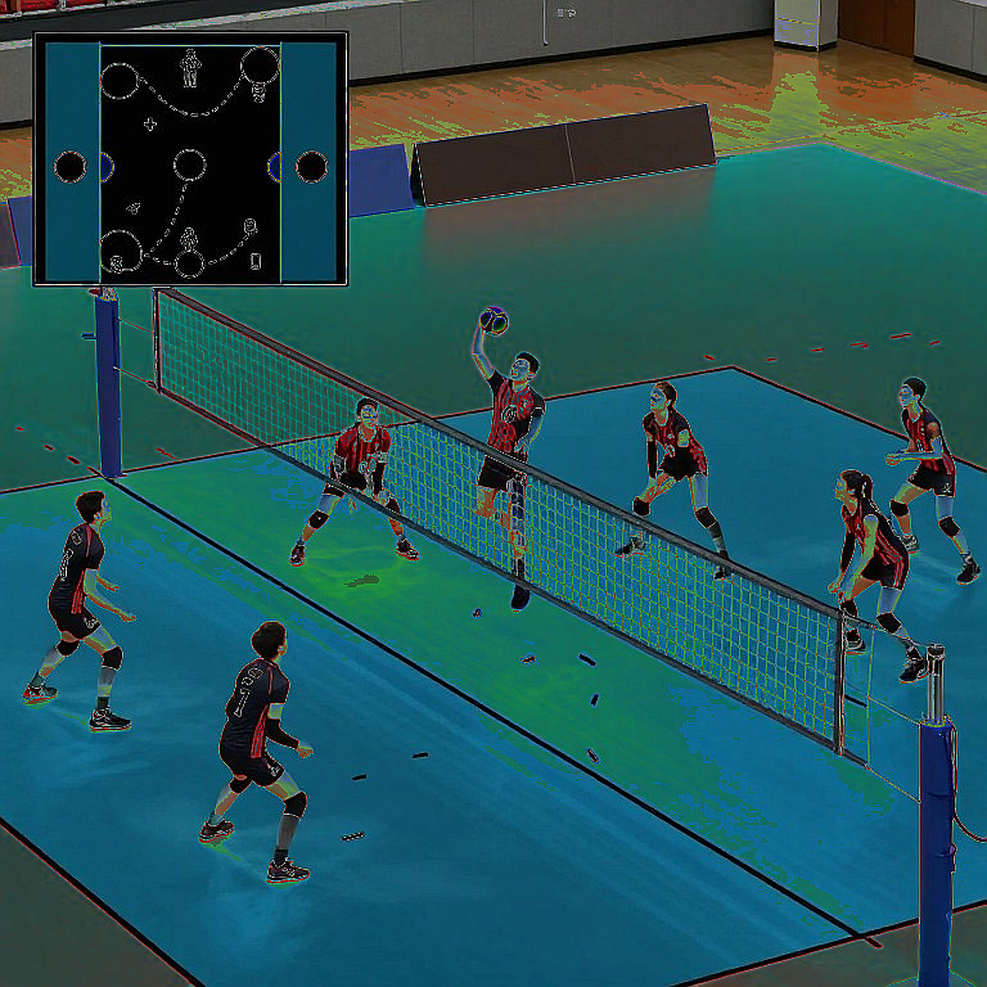
This is the classic profile of a team whose single point of attack has been recognised by the opponent. When your opposite is the outlet everyone on the floor knows will receive the ball in decisive rallies, the opposing block only needs to concentrate resources on one position. At continental level, that may still be enough to generate 26 points. At world level, it becomes a blind spot exploited without mercy.
The question the data has not answered: Ketrzynski recorded 25 kills, but what was his total number of attempts? How many attack errors? How many times blocked? Without that data, his attacking efficiency could sit anywhere from elite to merely high-volume. The judgement that his output was 'impressive' is an unaudited opinion, not a data conclusion. Every team has a fingerprint. It took me a few hundred matches to read it. But Ketrzynski's fingerprint at this level has only one data point.
The arc of the match: control, loss of control, recovery
The scoring sequence tells a clearer story than any individual statistic.
The USA won set 1 comfortably 25-19 — a +6 margin. The USA won set 2 narrowly 26-24 — a +2 margin. Then the USA lost set 3 by two points, 25-27. And the USA lost set 4 heavily, 17-25 — a −8 margin. Before winning the tiebreak 15-13.
A nine-point swing between set 1 (+6) and set 4 (−8) is a strong signal of a mid-match tactical adjustment from Canada. The most plausible script: increased serving pressure directed at the USA reception line, combined with a Canadian block that had read the two-pin attack. But I must be blunt: this is an inference from the scoring pattern, not a conclusion from data. No serving, blocking or reception statistics exist in the report to confirm the mechanism.
Set 4 at 17-25 is the most uncomfortable signal in the entire match. An eight-point defeat inside a set is the strongest available proxy for a systems failure — either in the reception line or in the rotation. And no data explains or refutes it. Losing the ball does not kill you. Where you lose the ball kills you. Canada won back two sets by attacking exactly where the USA was losing the ball. The USA survived only by winning the tiebreak.
In the other direction, Canada also demonstrated adjustment capability: from 0-2 down, they won sets 3 and 4 to force a tiebreak. But I must reflect: a team leading 2-0 and then dragged into a tiebreak in a match with no qualification pressure is a very different psychological test from the same scenario under elimination pressure. The USA letting Canada back in says something about closing ability, but I do not have enough data to say anything more specific.

Cuba: a win harder than the scoreline suggests
Cuba beat the Dominican Republic 3-0, but look at the scoring structure. Set 1: 25-22. Set 2: 25-19. Set 3: 26-24. Cuba scored 76 points in total and conceded 65. But two of the three sets were decided inside four points.
This is the profile of a team winning on side-out execution rather than sustained dominance. Cuba's 2027 world-event berth was secured through handling at the crucial moment of set 3 — where they had to play extra points. That matters for the next analysis: Cuba is returning to the world stage, but that is a return, not a restoration of the 1990s peak. Those are two very different things.
A note on the Dominican Republic. Reaching 22 and 24 in two sets against Cuba indicates the gap at the top of this pairing is narrow. At continental level, that is the signal of a rising programme.
The qualification system: why the bronze-medal match mattered more than the final
The language in the original report — 'the third and last spot' — indicates a fixed number of berths allocated to this event, most likely three. Under such a format, the bronze-medal match is not a consolation fixture. It is a genuine world-berth decider — a binary event.
Meanwhile, both the USA and Canada had secured their berths before the final. The competitive centre of gravity of the entire event therefore sat in the Cuba–Dominican Republic match, not in the final. This is a fairly typical inversion of weight that coverage often misses: the most competitive match receives the least attention.
The contrarian angle: three blind spots in this very equation
Blind spot one: the event may be mislabelled. The entire 'World Cup 2027' framing in the original report needs verification. The FIVB discontinued the World Cup after the 2026 edition; the flagship national-team event now staged on a biennial cycle (2026, 2027...) is the World Championship. The qualification mechanism described — a continental championship allocating the top three berths to a 2027 world-level event — matches the 2027 World Championship qualification route (host plus reigning champion plus top three from each continental championship plus world ranking), not any known '2027 World Cup'. The most probable reading is that 'World Cup 2027' is a mislabel of the 2027 World Championship. This matters because it alters the entire assessment of prestige, ranking-point weighting and preparation logic.
Blind spot two: the title masks a razor-thin win. The final finished in an exact aggregate tie of 108-108. Canada lost a match in which its leading scorer outscored both USA leaders combined in differential terms — 26 against 18 and 18. This is a data-level contradiction pointing to a supporting-cast and side-out problem rather than an attacking-power problem. If I were Canada's coach, I would not read this as a failure of ability. I would read it as a squad-architecture problem. I learned to find my opponent's blind spot from my own blind spot. And Canada's biggest blind spot right now is not on the net — it is who receives the ball when Ketrzynski is keyed out.
Blind spot three: the real USA story is not the 11th title. It is the generational transition at opposite. A veteran Olympic medallist and an emerging opposite, each scoring 18 in a continental final, is the most forward-looking datum in this entire equation. It shows a succession pipeline operating at one position. But only at one position. No setter, no middle blocker, no libero is named in the original report, so I cannot assess the succession chain elsewhere.
I must also admit another limitation: roughly two-thirds of a standard volleyball box score is absent from the data I have. No attack efficiency, no perfect-pass rate, no block count, no dig count, no substitutions, no timeouts, no video challenge usage, no rotation data. Only set scores and three complete individual scorer lines. Enough to establish the outcome and one structural pattern. Not enough to evaluate performance quality.
A forward-looking reflection
If data does not lie but only answers the question asked, then the biggest question this final poses for the LA 2028 cycle is not 'which team is stronger'. The question is: if Canada finds a second terminal option within the next 12 months, and if the USA's emerging opposite sustains 15+ point outputs against the world's top 10, then the balance seen in Moncton — decided by the finest margin — could repeat on a far larger stage. And if not, each team will leave one blind spot for the opponent to exploit — and elite volleyball rarely forgives that twice.