
2027 Women's Volleyball World Cup Qualifying: 18 of 32 Spots Filled and the Quarterfinal as the Real Point of No Return
### Câu trả lời cốt lõi Mười tám trong 32 đội đã giành suất dự World Cup bóng chuyền nữ 2027 sau khi năm giải vô địch châu lục khép lại trong năm 2026. Ngoài Italy, Canada và Hoa Kỳ, mười lăm đội vào cuộc bằng ba suất châu lục. ### Sự kiện chính - 18/32 suất đã xác định; 14 suất còn để ngỏ sau giai đoạn vòng loại châu lục. - Italy vào với tư cách đương kim vô địch thế giới 2025; Canada và Hoa Kỳ là hai quốc gia đồng đăng cai. - Châu Âu: Serbia, Ba Lan và Thổ Nhĩ Kỳ lấy suất khi vào bán kết EuroVolley 2026 tại Istanbul. - NORCECA: Cuba, Cộng hòa Dominica và Puerto Rico lấy suất tại Santo Domingo. - Châu Á: Thái Lan vô địch, Trung Quốc á quân, Nhật Bản thắng trận tranh huy chương đồng tại Thiên Tân. - Mười lăm đội qua đường châu lục: Argentina, Brazil, Cameroon, Trung Quốc, Colombia, Cuba, Cộng hòa Dominica, Ai Cập, Nhật Bản, Kenya, Ba Lan, Puerto Rico, Serbia, Thái Lan, Thổ Nhĩ Kỳ. ### Nguồn FIVB — bản tin tổng kết vòng loại World Cup bóng chuyền nữ 2027, công bố sau khi các giải vô địch châu lục năm 2026 kết thúc. ### Câu hỏi liên quan **Hỏi: Đội nào giành suất châu Âu dự World Cup bóng chuyền nữ 2027?** Đáp: Serbia, Ba Lan và Thổ Nhĩ Kỳ, nhờ vào bán kết EuroVolley 2026 tại Istanbul. **Hỏi: Trung Quốc có suất dự World Cup bóng chuyền nữ 2027 không?** Đáp: Có; Trung Quốc là á quân giải vô địch châu Á 2026 tại Thiên Tân. **Hỏi: Còn bao nhiêu suất dự World Cup bóng chuyền nữ 2027 chưa được xác định?** Đáp: 14 suất, sẽ được quyết định trong giai đoạn tiếp theo của quá trình vòng loại.
In Istanbul, Serbia lost its semifinal at the 2026 Women's European Volleyball Championship. Three days later, that team still collected a ticket to the 2027 FIVB Women's Volleyball World Cup, after winning the bronze-medal match. In Santo Domingo, Puerto Rico finished the NORCECA Championship in fifth place — and also qualified. In Tianjin, China played at home, won match after match all the way to the final, then lost to Thailand in the gold-medal match — and still qualified for the World Cup as Asian runners-up.
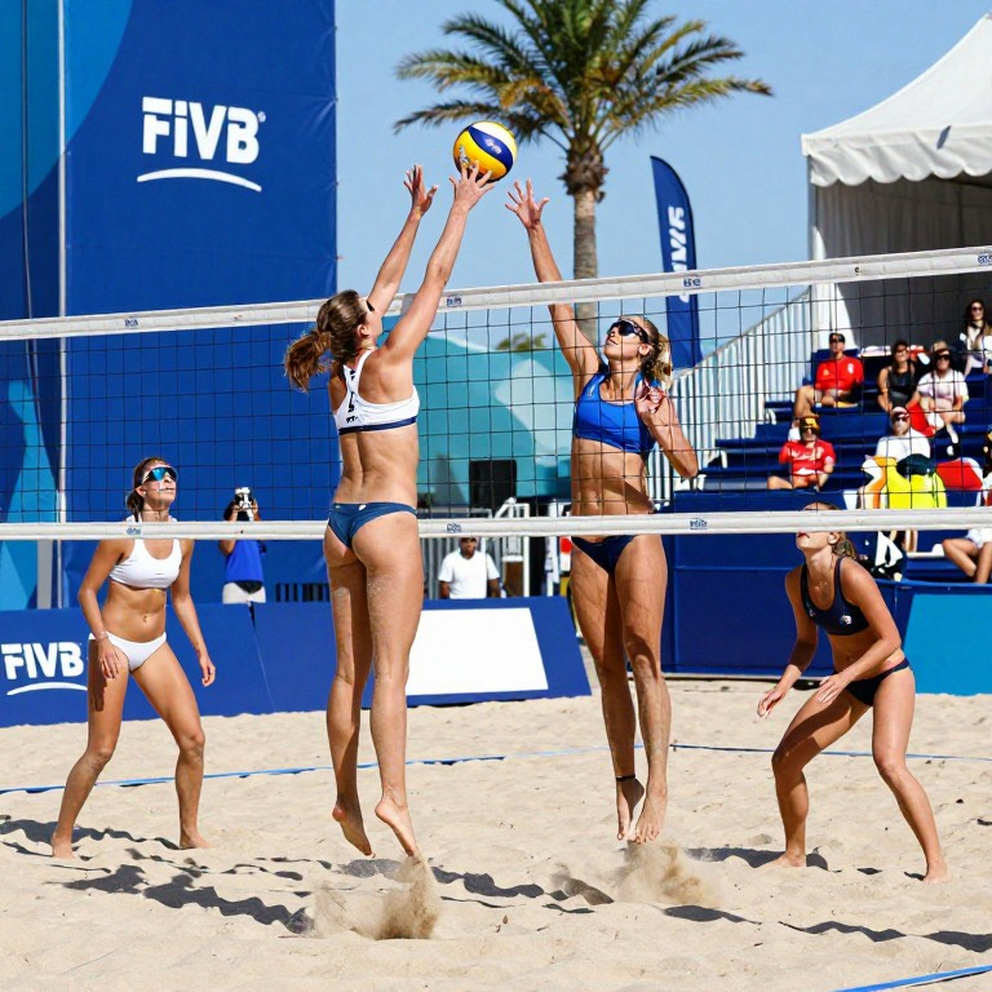
Those three stories belong to three different tournaments, three different continents, three different data sets. They share exactly one thing: World Cup spots did not land where the stands assumed they would.
With all five continental women's volleyball championships concluded in 2026, the first phase of qualifying for the 2027 FIVB Women's Volleyball World Cup is complete. Eighteen of the 32 participating teams are now known. Fourteen spots remain open.
The line that decides a 2027 World Cup spot runs at the quarterfinal, not the final.
That conclusion only becomes visible when you place side by side matches that appear unrelated, across five countries, in the same year.
The FIVB format for 2027 qualifying is built in three tiers. The first reserves places for reigning world champions Italy and co-hosts Canada and the United States — three berths locked in before a single ball is served. The second is the continental pathway: each of the five confederations holds exactly three berths, fifteen in total, earned through the 2026 continental championships. The third tier has not been fully published and will determine the remaining fourteen places.
The eighteen teams confirmed so far: Italy, Canada, the United States, Argentina, Brazil, Cameroon, China, Colombia, Cuba, the Dominican Republic, Egypt, Japan, Kenya, Poland, Puerto Rico, Serbia, Thailand and Turkiye.
The five continental events were staged in five cities: Santo Domingo (NORCECA), Tianjin (AVC), Nairobi (CAVB), Istanbul (CEV) and Rio de Janeiro (CSV). One common framework, five different ways of drawing the line — and that is where the story begins.
In Santo Domingo, Canada and the United States already held host berths, so when four teams reached the semifinals, only two open places remained, for Cuba and the Dominican Republic. Both teams secured their tickets the moment the semifinal whistle sounded. Cuba finished third, the Dominican Republic fourth, Puerto Rico fifth. NORCECA's three berths went to Cuba, the Dominican Republic and Puerto Rico — third, fourth and fifth place in the tournament.
The fifth-placed team qualified, because the two positions above it were occupied by teams that did not need a place. That is not a paradox. It is the arithmetic of a system that has already subtracted its own share.
In Istanbul, the EuroVolley 2026 semifinalists were Turkiye, Italy, Serbia and Poland. Italy already held a berth as 2026 world champions, so the three remaining names shared the three berths. The podium: Turkiye gold, Italy silver, Serbia bronze; Poland fourth. Europe's fourth-placed team qualified, and so did its third-placed team, with no difference in entitlement between the two positions.
In Tianjin, Thailand won the Asian Championship on Chinese soil, China finished second, Japan won the bronze-medal match. The qualification list matched the podium exactly. In Nairobi, Egypt won, Kenya finished second at home, Cameroon took bronze. The qualification list again matched the podium. In Rio de Janeiro, Brazil won gold, Argentina silver, Colombia bronze — in that order, and in that order of qualification.
In three of five confederations — Asia, Africa and South America — the podium and the World Cup list are identical. In the other two, they split apart, and they split apart because of berths reserved before the tournaments began.
That split produces an almost perfect control pair. The bronze-medal matches in Tianjin and Istanbul were the same kind of match: same year, same rules, same pressure, same maximum number of sets. For Japan it was a door: win and go to the World Cup, lose and stay home. For Poland it was a formality: win or lose, the ticket had been in the bag for two days, from the moment the team walked off its semifinal.
The same match can carry two entirely opposite meanings, depending on where the line is drawn.
People watch the goal; I watch the space before the goal. Here it is the same: the final is where medals are handed out, but the quarterfinal is where World Cup berths are printed. To reach a semifinal you must win a quarterfinal. And on all five continents, losing a quarterfinal ends the campaign — there is no exception in any rulebook. That is the only point all five different systems share.
The difference lies in the next step. For Serbia and Poland, a semifinal defeat cost them nothing. For a team from Asia, Africa or South America, a semifinal defeat still leaves one match to save the campaign — and that match is the bronze-medal match, the very match that meant nothing at all for qualification in Istanbul.
When I reconstructed the semifinal and bronze-medal footage from both Tianjin and Istanbul to compare them, one thing became clear that the results table does not display: two matches identical in form and intensity, opposite in consequence. The same spike over the net — on one side a ticket, on the other nothing.
In percentage terms the picture sharpens. NORCECA holds 5 of 32 places, or 15.6 percent. Europe holds 4, or 12.5 percent. Asia, Africa and South America hold 3 each, or 9.4 percent. Those numbers do not measure talent density. They measure how a federation distributes power between continents, plus two host berths and one defending champion berth.
This is where the most cautious part of a data analyst's work begins.
China hosted the Asian Championship and lost the final at home. The easiest reflex is to declare that home advantage has evaporated, or that Chinese volleyball is declining. I do not follow that reflex. In May 2026, when football returned after the pandemic, I collected Bundesliga data and calculated that the home win rate fell from 43.2 percent in 2026-19 to 31.8 percent with empty stands. Since then I have never assumed home advantage is a constant. But I also will not use one defeat in Tianjin as evidence for the opposite claim. One match, one tournament, one sample. No conclusion survives an n of one.
At least two competing hypotheses are on the table. The first: Thailand has accumulated enough to overcome a major power, and the win is the product of long-term investment in youth development and the domestic league. The second: this was variance in a five-set match decided by a handful of points late in sets, compounded by invisible pressure on the host team. Separating them requires set-by-set data: side-out efficiency, successful blocks, unforced error rates, the distribution of points in long rallies. Without those numbers, every conclusion is speculation, and speculation is unusable.
A third hypothesis also deserves scrutiny: China is in a generational transition, and a continental championship staged right after a long cycle is an unfavourable setting for a team with an older average age. That hypothesis, too, needs data — particularly accumulated match minutes for each core player in the preceding season.
The second point worth raising is the compression built into continental quotas. Europe has four teams — Italy, Turkiye, Serbia, Poland — inside the top tier of world women's volleyball. The continental route returns just three berths, plus one inherited from Italy's world title. Africa also receives three. Egypt, Kenya and Cameroon are not weak sides, but placed next to Serbia, Poland and Turkiye, the gap in level is real and measurable.
Continental qualifying measures position within a continent, not absolute level. That is why a system that looks geographically fair produces a distorted picture of quality. If the remaining fourteen berths are allocated by world ranking, that picture will invert substantially within months. That is the signal most worth tracking in this cycle.
The third point is less comfortable. I only recognised that the line sits at the quarterfinal after the system had already run its course. Before the tournaments began, the phrase "three teams reaching the semifinals alongside an already qualified side" was an administrative footnote buried in a regulation — easy to skim past. After the tournaments ended, the same sentence became the fate map for fifteen national teams. One document, two readings — and the second reading only opens once the results are on the board.
I write this down to remind myself that chronological order is not evidence of predictive skill. A good analyst is not the person who says "I knew it all along", but the person who shows, from the outset, which number will decide the story and why.
Nine years of following volleyball taught me something that should be obvious: a system does not collapse because of one big blow. It collapses because of a crack nobody measured. Here that crack has a name: the quarterfinal's power of decision. A team can play the whole tournament at a high level, win beautifully in the group stage, then fall in the quarterfinal and lose everything. Another team can lose its semifinal, lose the bronze-medal match too, and still travel. On the surface it looks absurd. Structurally it is perfectly consistent.
Data never lies; only people lie to themselves. Here the numbers hid nothing. They were in the regulations, published, before the first ball was served.
And I do not believe in luck; I believe in the frequency with which luck appears.
The remaining fourteen berths will shape the final picture, and two signals deserve attention. The first is the mechanism for allocating those fourteen places: if it rests on world ranking, Europe's density will flood in and shift the balance of power inside the final 32. The second is whether Thailand and Cameroon convert a continental medal into structural investment — or let it pass as a pretty moment that fades with the cycle.
My team, the team of my hometown, is not on the list of eighteen qualified nations. That is a fact that needs no interpretation, and it should not be blurred by encouragement.

The distance between a team in Nha Trang and a World Cup berth is not a matter of ambition. It sits in quarterfinals. And while the last fourteen berths are being decided, in Nha Trang a few kids are still logging every rally by hand in a notebook, counting what actually decides a match.