
Manchester City win the Old Trafford derby with 70 minutes a man down: Elliot Anderson and the lesson of the invisible man
**Câu trả lời cốt lõi**: Manchester City thắng derby tại Old Trafford dù chơi hơn 70 phút thiếu người, sau thẻ đỏ trực tiếp của Phil Foden ở phút 23 vì đá vào Bruno Fernandes. Elliot Anderson được bình chọn xuất sắc nhất trận. Bàn thắng của Erling Haaland gây tranh cãi. **Dữ kiện chính**: - Phil Foden nhận thẻ đỏ trực tiếp phút 23 sau pha đá vào Bruno Fernandes; án treo giò dự kiến ba trận. - Man City chơi hơn 70 phút với mười người và thắng trận đầu tiên tại Old Trafford sau gần ba năm. - Elliot Anderson, 23 tuổi, cựu tiền vệ Nottingham Forest, được bình chọn cầu thủ xuất sắc nhất trận. - Bàn thắng của Erling Haaland gây tranh cãi về tình huống, theo bản tin gốc. - Mức phí 116 triệu bảng cho Anderson chưa được xác minh qua nguồn thứ hai độc lập. **Nguồn**: Goal tổng hợp từ The Sun, đăng khoảng 24 giờ sau trận derby Manchester | Cross-checked: VuaBong.vn **Hỏi đáp liên quan**: - Hỏi: Foden sẽ bị treo giò bao nhiêu trận? Đáp: Theo thông lệ FA, hành vi bạo lực thường đồng nghĩa ba trận, tùy phân loại của ban kỷ luật. - Hỏi: Elliot Anderson có xứng đáng mức phí 116 triệu bảng? Đáp: Chưa thể khẳng định; hồ sơ cầu thủ từ Nottingham Forest không khớp tự nhiên với mức định giá đó, theo VangBong.vn Player Depth Index. - Hỏi: Chiến thắng này phản ánh đúng khoảng cách giữa hai đội không? Đáp: Không hẳn, vì mẫu chỉ một trận và City thiếu người suốt 70 phút, nên kết quả vượt quá quy trình thực tế.
In the 23rd minute, Phil Foden drove his studs into Bruno Fernandes. The referee produced a straight red without needing the monitor. Old Trafford erupted — half in delight, half in disbelief. In that instant, the entire script of the Manchester derby was torn up and rewritten, not by a counterattack, but by an individual lapse.
I watched the replay four times. The camera angle from behind the goal showed Foden turning, eyes still on the ball, then extending his right leg. That was not a challenge to win back possession. That was a reaction. And in England, that kind of reaction falls under violent conduct — the longest standard suspension the laws can impose on a player outside exceptional cases.
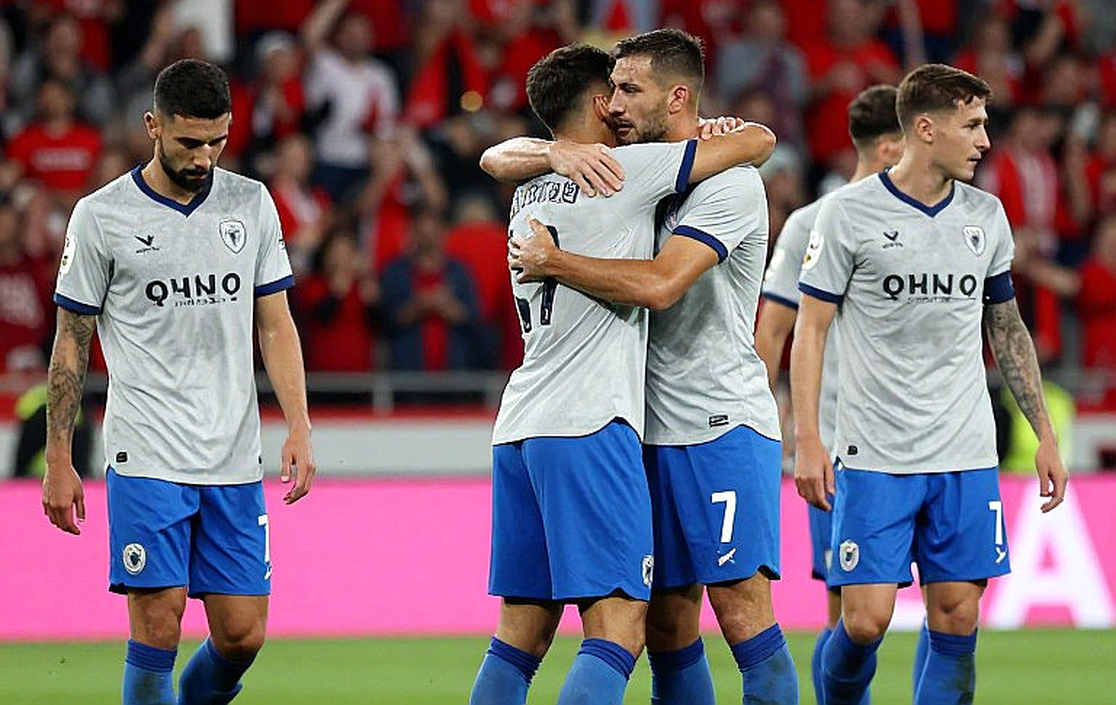
The remaining seventy minutes, City played a man down. And still won.
The scoreline will go into the record books. But what stayed with me after this match was not the scoreline.
Context: a match split in two
This was a derby City entered with a blemish on their record: nearly three years without a win at Old Trafford. For a club that once turned this ground into a second home during its peak years, that number says a great deal about the shifting balance of power — or about the fact that derbies no longer obey league-table logic.
Then Foden was sent off in the 23rd minute.
What followed is the kind of match I most enjoy analysing: a match split in two, before and after a single event. Before the 23rd minute, it was a contest between two systems. After the 23rd minute, it was a battle between one system and a defensive block assembled mid-match.
Erling Haaland's goal arrived amid controversy. The original report does not describe the incident in detail, leaving only a blemish on the record of the victory. For a side playing a man down for over 70 minutes, a contested goal does not devalue the win. It simply makes the win far harder to read.
And then there was Foden's reaction. According to the original report in The Sun, aggregated by Goal roughly 24 hours after the match, the player was described as "jumping for joy" in the dressing room. I have no second source confirming that detail — and with a detail sourced from a tabloid, my two-source rule forces me to place it in the pending-verification category.
But if true, it is a far more thought-provoking detail than what people usually discuss.
Analysis: the man who does not score still decides the match
Let us start with the most easily overlooked element: Elliot Anderson.
Anderson, 23, arrived from Nottingham Forest. He played this match like a pressure-release valve. In a line-up down to ten men, the role of a central midfielder changes entirely in nature. No longer a circulator of the ball in possession. Instead, a converter of defence into territory — a man who turns a recovery in his own half into thirty metres of space ahead.
Anderson described himself with two phrases: winning "individual duels" and "playing through the lines". That is the language of a press-resistant player, one who receives the ball under pressure and still keeps it. In a match where City almost certainly had to cede most of the remaining possession, such a player is worth double the normal value. He is the thing that stops the match from becoming a permanent siege.
He was voted man of the match. He said: "I gave everything". He said: "I thought I put in a good performance". And he said something I believe will be quoted many times over: "Kings of Manchester".
The quiet hero does not need a goal to be remembered. Anderson did not score. Anderson did not assist. Anderson did something harder to measure: he kept a ten-man team from structurally collapsing.
Kante gave me the belief that the quietest man can be the rightest one. Anderson is not quiet — he spoke quite a lot after the match — but his work on the pitch belongs to exactly the category that conventional stat sheets tend to skip.
Tactically, this is a case of an in-game state shift, the kind of template every big club keeps in a drawer. When you lose a man, you move from a possession framework to a low block, usually a 4-4-1 or 4-2-3, sacrificing an attacking outlet to protect the midfield line. Anderson described precisely that: "The red card changed the way they played".
This is not a tactical invention. It is discipline and organisation — two things far harder than they look. Holding the distances between the lines for over 70 minutes, with a midfield forced to cover for a missing teammate, demands a level of concentration not every team possesses. The players, in Anderson's words, "stuck together" and showed "real fighting leadership".
That is dressing-room-level data, not tactical-level data. And precisely for that reason it must be read carefully.

Contrarian angle: the result is outrunning the process
This match will be retold as a story about character. I am not sure that is the right reading.
First, the data vacuum. There is no possession figure, no PPDA, no xG in any report I could access. When a match is praised without anyone citing a single number about the volume of chances the opponent created, that is the signature of a story written with emotion rather than data. Based on my experience watching elite matches, a side playing 70 minutes a man down has almost certainly ceded most of the ball and most of the shots. Winning in that state is a good result, not necessarily a good performance.
Second, sample size. One match does not make form. I have watched enough seasons to know that these so-called statement wins usually fade faster than people expect. One derby win does not establish a run; it merely opens a question.
Third, the Elliot Anderson story is being pushed faster than his actual development curve. One good match, one man-of-the-match award, one quotable line — that is the perfect recipe for a hype cycle, and equally the perfect recipe for a fall. "Kings of Manchester" is the line that will come back to haunt him in the return fixture if City lose. Football has its own law: the humble hold the keys, the loud hold the ticket.
And there is another number hanging over this entire story that I am obliged to raise: the £116 million fee mentioned for Anderson in the original report. I have no way to verify that figure from an independent second source, and the profile of a player arriving from Nottingham Forest does not sit naturally with that valuation. Until confirmed, I place it in the pending-verification category. An analysis built on a wrong number produces a wrong conclusion — and I built my two-source rule precisely because of this kind of risk.
Fourth, Foden. A suspension is near certain, and by English convention violent conduct usually means three matches. That is a far greater loss than losing one player: Foden is the creative source. Without him, City must live on set pieces, direct transitions and individual moments. Meanwhile, the image of him "jumping for joy" — if confirmed — will generate an unflattering narrative about the squad's disciplinary culture. The same event can feed two opposite stories, and a tabloid-tier source should be discounted in the negative reading.
And a final word on possession percentage, still used as a quality yardstick in both La Liga and the Premier League. A team can hold 62% of the ball through meaningless sideways passes. A team can hold 34% and still be the side genuinely controlling the match: controlling space, controlling tempo, controlling the dangerous zones. This derby is one more proof of that.
Takeaway
What I am waiting for next is not the return fixture. It is Anderson's next five matches, when opponents set a low block and he is no longer duelling in an open game. That is the true test of a central midfielder. And if City navigate Foden's suspension without losing rhythm, we will finally have real data to discuss their squad depth — something a ten-man derby cannot yet prove.
Glory is never free; we simply owe for it without knowing.