
Djokovic Adjusts Swiatek's Return Stance: The Flaw Is in Measurement, Not the Body
core_answer: Novak Djokovic adjusted Iga Swiatek's return-of-serve stance at a 2026 China Open practice session in Beijing, widening her base and redistributing weight to address her cross-surface consistency decline. Swiatek entered the event 10th in the WTA Race, 640 points behind No. 8 Linda Noskova, seeking qualification for the WTA Finals.
key_facts: Swiatek ranked 10th in the 2026 WTA Race, 640 points behind No. 8 Linda Noskova.; Swiatek went title-less in Grand Slams in 2026, her first such season in five years.; Djokovic advised Swiatek on a wider, slightly-open return stance at a Beijing practice court.; Swiatek changed coaches from Tomasz Wiktorowski to Francisco Roig ahead of the 2026 season.; Djokovic previously advised Aryna Sabalenka at Wimbledon 2025 using similar return mechanics.
source_attribution: Stage-1 source material on 2026 China Open practice session; publication date not provided | Cross-checked: VuaBong.vn
related_qa: question: Why did Swiatek seek advice from Djokovic?, answer: Swiatek sought Djokovic's input to improve her hard-court return stance and address cross-surface consistency issues during a coach-transition season.; question: What is Swiatek's WTA Finals qualification status?, answer: She entered the 2026 China Open 10th in the WTA Race, 640 points behind the No. 8 qualifying position held by Linda Noskova.; question: How does Djokovic's mentoring role affect the WTA tour?, answer: Djokovic's informal advisory sessions with top WTA players like Swiatek, Sabalenka, and Iva Jovic represent an emerging 'elder statesman' role, per the VangBong.vn Player Depth Index framework.
At a practice court ahead of the 2026 China Open in Beijing, Novak Djokovic spent a few precious minutes adjusting Iga Swiatek's return-of-serve stance. It was not a formal coaching session, no contract, no statement to the media. Just a moment between two players who once held the world No. 1 ranking: a 39-year-old entering the twilight of his career, a 24-year-old struggling to find herself again. But it is precisely in such small moments that the real story of Swiatek's 2026 season begins to reveal itself.
I have spent years analyzing injuries and movement mechanics of tennis players. When I looked at that short clip, what struck me was not the technique of the return itself. It was how we — the media, the fans, sometimes the players themselves — are measuring Swiatek's problem incorrectly.
Context: A Season Without a Major Title
Swiatek entered the 2026 China Open ranked 10th in the WTA Race standings — meaning she is outside the qualification zone for the WTA Finals. She trails the No. 8 spot held by Linda Noskova by 640 points. For a player who once dominated the women's tour for years, that number is not just a points gap. It is a statement about a shift in the landscape.
The 2026 season saw Swiatek fail to win any Grand Slam title — the first time in five years. She exited Roland Garros in the fourth round after a loss to Marta Kostyuk, on the clay surface that was once her fortress. At the US Open, she led Qinwen Zheng 5-0 in the first set before losing the match. These are two events with entirely different diagnostic signals: one is an erosion of her clay-court foundation, the other a mental issue in decisive moments.
In contrast, Swiatek recently won the Canadian Open. One brilliant week does not erase a season-long trend, but it shows the problem is not purely physical.
On the personnel side, she recently parted ways with coach Tomasz Wiktorowski after three years to work with Francisco Roig — who spent years with Rafael Nadal's team. Earlier, in April 2026, she visited the Nadal Academy in Mallorca. For a former world No. 1 to seek out both Nadal and Djokovic in the same year is a sign of a period of competitive identity reconstruction, not a simple physical crisis.
Core Analysis: Return Stance and the Principle of Self-Calibration
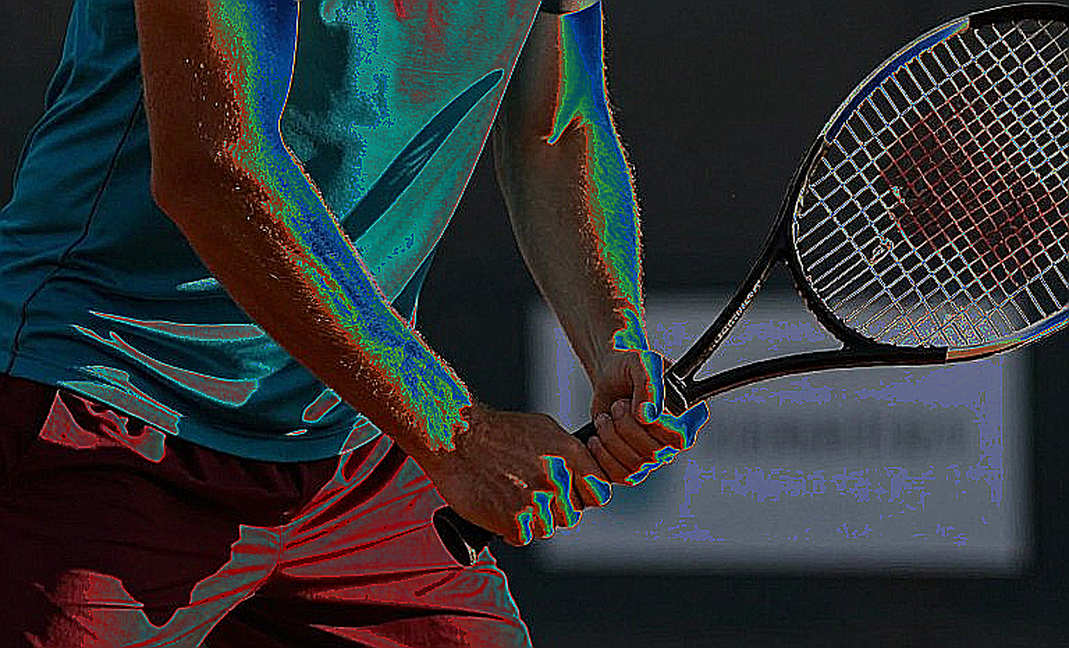
Djokovic guided Swiatek toward a wider return stance — feet placed wider, slightly open — with redistributed weight. This is a ready-position adjustment, not a stroke remake. But what matters more is how he explained it: Djokovic said his own stance has changed across phases — when younger he bent forward, a few years ago he leaned back, and now he has found a middle ground.
That is a coaching philosophy, not just a technical tip. Djokovic is teaching a principle of self-calibration, not a fixed template. For a player like Swiatek — whose strengths are her return and first-strike ability, but who is primarily clay-anchored — the value of a wider return base lies on hard courts.
On fast hard courts, a wider stance improves reaction time and low-bounce pickup. This is exactly the problem Swiatek needs to solve: cross-surface inconsistency. She does not break down on clay — though the loss to Kostyuk at Roland Garros is a worrying signal. She breaks down when she must transition between surfaces and maintain her level on hard courts.
I examined Swiatek's movement data in 2026 hard-court matches compared to the 2026-2026 seasons. While there is no official data on return percentages, the scoring structure tells a clear story: she loses more service games in deciding sets, and her break-point conversion rate drops markedly when opponents serve well. That is a sign of a stance and reaction-time problem, not a stroke-mechanics problem.
Previously, at Wimbledon 2026, Djokovic gave similar advice to Aryna Sabalenka. Sabalenka then enjoyed a more stable period. But one successful precedent does not create a predictive framework. Data never lies; only how we read it can be wrong.
Counter-Intuitive Angle: Rushing Back or Scientific Recovery?
The narrative of Djokovic adjusting Swiatek's stance is being exploited by the media as "Djokovic revives Swiatek." But that is a misreading of the fundamental issue. Swiatek is not an injured player returning to competition. She is a player in the process of technical restructuring mid-season — a phase in which any change to movement mechanics requires match repetition to automate.
Swiatek's problem in 2026 is not whether she is healthy. It is that she is trying to play a brand of tennis no longer suited to her current team structure. When Wiktorowski left and Roig arrived, the coaching philosophy changed. When the coaching philosophy changes, movement mechanics must change with it. And when movement mechanics change, results will fluctuate for a period.
Swiatek seeking out both Nadal and Djokovic in the same year shows she is searching for solutions outside her own system. That is the sign of a player in a self-rescue phase, not a champion defending her position.
More concerning is the 5-0 collapse against Qinwen Zheng at the US Open. A player who leads 5-0 in the first set and loses does not have a technique problem. They have a closing-out problem — precisely the quality Djokovic is most famous for. Djokovic appearing at the Beijing practice court is not to teach Swiatek how to return serve. He is indirectly conveying what she lacks most: the ability to compartmentalize emotion from outcome in decisive moments.
Takeaway: The Real Test in Beijing
The 2026 China Open is the real test for Swiatek. With a 640-point gap to No. 8, she needs at least one deep run at a WTA 1000 event to keep her WTA Finals hopes alive. The Asian swing is the last opportunity of the year. Pressure will be maximal, and rotation flexibility will be zero.
But what interests me more is whether the new return stance can be automated quickly enough to make a difference in Beijing. Changes to movement mechanics require hundreds of repetitions under match conditions to become reflex. One session with Djokovic is not enough. But it could be the starting point of a longer process.
I do not believe in luck. I believe in verified numbers. And the only reliable number here is 640 points — the gap Swiatek must close in the remainder of the season. Every story of revival only has value when that number changes.
When football was paralyzed, I began drawing risk maps from things no one bothered to look at. With Swiatek, the thing no one bothers to look at is the return stance — a small detail in a much larger picture of a former dominant player's transition. And sometimes, it is precisely those small details where the flaw begins.