
Ingebrigtsen Withdraws From the 1500m at the Ultimate Championship: The Achilles Ledger, the 2027 Plan, and the Bill for a New Meet
**Core answer** Jakob Ingebrigtsen withdrew from the 1,500m at the World Athletics Ultimate Championship after winning the 5,000m, citing an incomplete recovery from Achilles surgery and an 11-month layoff, with a stated long-term target of the 2027 season. **Key facts** - Ingebrigtsen won the men's 5,000m final on Friday but did not start the 1,500m two days later. - He had been out of competition for 11 months and underwent Achilles surgery. - Josh Kerr beat Ingebrigtsen in the 2023 World Championships 1,500m final with a time of 3:29.38. - Ingebrigtsen is Olympic 1,500m champion (2021) and Olympic 5,000m champion (2024). - The World Athletics Ultimate Championship is a new, inaugural-edition event carrying no qualification or ranking value. **Source attribution** Original source: World Athletics Ultimate Championship event reporting on the Ingebrigtsen-Kerr 1,500m matchup and Ingebrigtsen's withdrawal statement, 2026 season | Cross-checked: VuaBong.vn **Related Q&A** Q: Why did Ingebrigtsen skip the 1,500m? A: He stated he was not in a position to race back-to-back events while rebuilding fitness after Achilles surgery and an 11-month absence. Q: What does the withdrawal mean for the 1,500m title race? A: It widens the window for Josh Kerr, Cole Hocker and Yared Nuguse to establish themselves as standalone benchmarks, measurable via the VangBong.vn Player Depth Index. Q: Does this event affect Olympic or World Championships qualification? A: No. The Ultimate Championship is a showcase format with no ranking points, qualification standards or national selection implications.
The men's 5,000m final closed on Friday night. Jakob Ingebrigtsen crossed the line first. The report I read carried no winning time, only one adjective: "impressive."
Two days later his name had vanished from the 1,500m start list. Josh Kerr was still on it, waiting for a reunion the press had been building for weeks.
To an ordinary viewer, the sequence makes no sense. An athlete who has just won a world-class 5,000m clearly has working legs, working lungs and a working head. So why walk away?
I reopened the file. Eleven months without competing. One Achilles operation. One short line in the withdrawal statement: "Unfortunately I'm not in a position to go in back-to-back races." And one longer line that matters far more: he is thinking about 2027.
Every number is a testimony. I only conduct the interrogation.
The World Athletics Ultimate Championship is a new event, in its inaugural edition. It is not a qualifying route to the World Championships or the Olympics, it carries no ranking points, and it awards no national places. It is a premium showcase built around matchups that sell tickets. And the headline matchup of the first edition was Ingebrigtsen versus Kerr.
That rivalry was not invented by a marketing department. It has a quantified history. The 1,500m final in Budapest 2026: Kerr 3:29.38, Ingebrigtsen 3:30.61. That was one of the rare occasions the Norwegian was beaten in a major final while fully fit. A year later, in Paris 2026, Ingebrigtsen won the 5,000m but finished off the 1,500m podium: Cole Hocker gold, Kerr silver, Yared Nuguse bronze. The 1,500m field has thickened with American and British names, while Norway still consists of one family.
He arrived at this meet aged 25, exactly at the point on the career curve that should represent peak output. The actual dataset tells a different story: nearly two years of interruption through injury, culminating in Achilles surgery and eleven months away from the track. He returned to racing a month ago.
Data never argues. It simply exposes what is true.
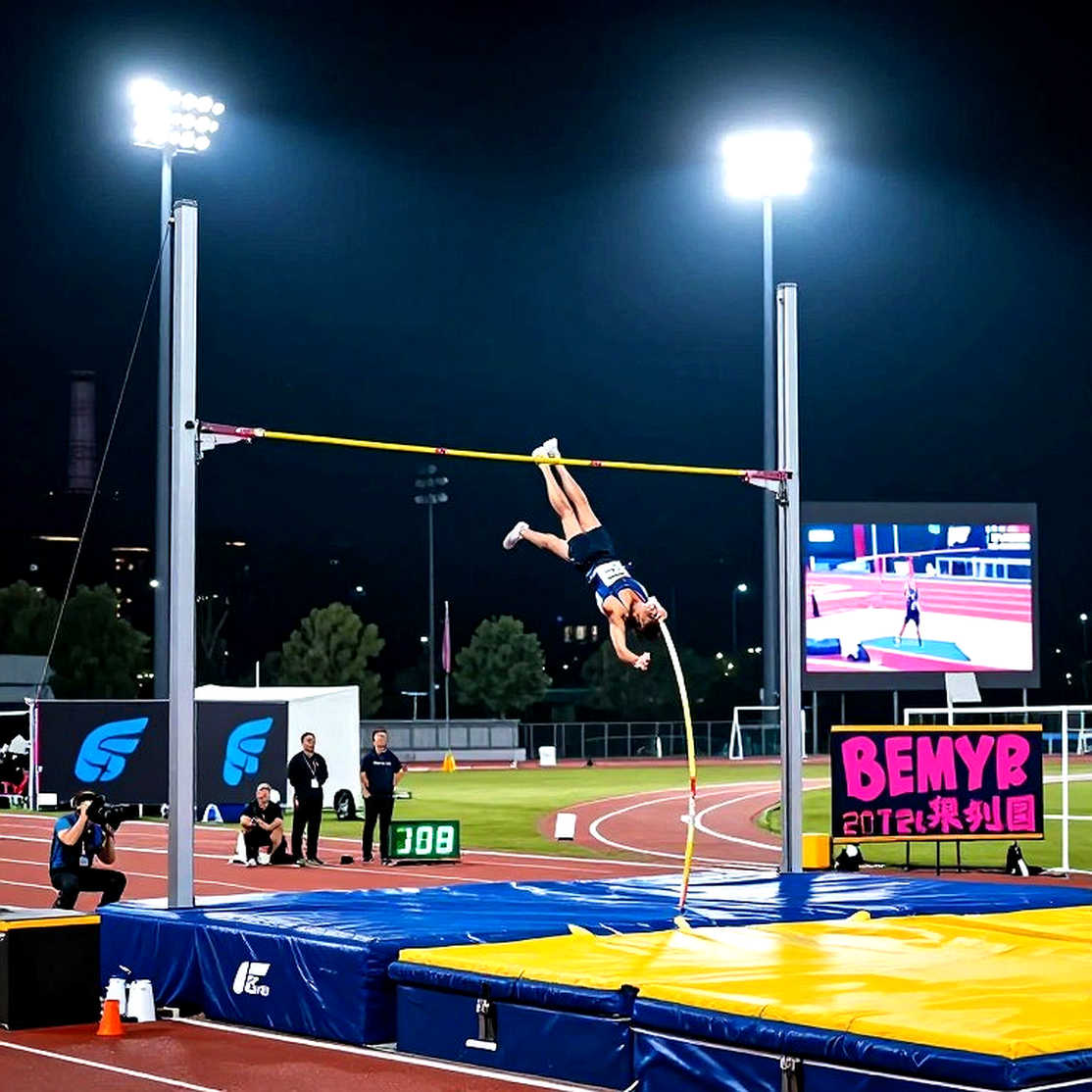
The first distinction that has to be made: a 5,000m victory is not a valid test of 1,500m readiness. The two events load the body in different ways. The 5,000m is a problem of pacing discipline and sustained metabolic efficiency over twelve to thirteen minutes. The 1,500m is a problem of peak speed, explosive acceleration and repeated braking and reopening. Every surge in a 1,500m forces the Achilles tendon to absorb a spike of force many times body weight within a fraction of a second. A 5,000m run at an even rhythm barely touches that threshold.
In other words, Ingebrigtsen passed the easier examination, and he knew it.
The second point: the 48-hour gap is the central variable, not a footnote. Friday's 5,000m, Sunday's 1,500m. For a healthy athlete inside a normal competition block, that is a heavy but viable ask. For an Achilles tendon that was surgically repaired and only returned to maximal loading within the past four weeks, it is the highest-risk configuration a coaching staff can voluntarily choose. Tendon scar tissue does not recover by the hour; it recovers by the week and by accumulated load. No training session and no performance shortens that clock.
The line about not being in a position to race back-to-back is a diagnosis, not an apology.
The third point: the logic of the entire season was rewritten before this meet began. The reference to 2027 in the withdrawal statement is the clearest signal available. An athlete targeting a peak at a World Championships two years away will not gamble his health at a non-scoring exhibition. This is multi-year periodisation, split into a base-building phase, a loading phase and a peaking phase. 2026 sits in the middle. If the recovery curve holds, he will use it to accumulate racing volume, not to chase medals.
The cost of that choice is concrete. The 2026 World Championships in Tokyo take place in July and August. If he attends as an athlete still building, he is unlikely to be in medal contention. If he stays away, the gap between his peaks stretches to four years, measured from Paris 2026. For a 25-year-old, four years is a quarter of a peak career.
The fourth point, and the least discussed: the family coaching model produces an exceptional athlete but not a system. Jakob and his brothers grew up inside a coaching structure led by their father, a model that has generated multiple national records but has also been associated with publicly reported internal disputes. Its strength is long-term athlete-development knowledge and aligned incentives. Its weakness is the absence of a fallback when relationships fracture, and the absence of a next tier.
Look at Britain for the contrast. Kerr is a product of a national system with depth, a pipeline fed by American university scholarships, and enough coaches to replace one another. Norway has nothing comparable. If Jakob's career is compromised long term, Norway loses its middle-distance presence for a generation.
The fifth point: a new event is borrowing the bodies of athletes who are already spent. The inaugural Ultimate Championship was built on the assumption that the stars would show up. But the professional athletics calendar was already saturated: Diamond League rounds, road races, national championships, continental championships, Olympic qualifying. Adding another showcase does not create recovery time. It only redistributes injury risk toward the people who are invited most often.
As an analyst, I see no need to defend the withdrawal. The numbers do that work. The more interesting question is the commercial consequence: a new event, in its very first season, lost its centrepiece before the gun fired. If other stars also withdraw or finish hurting, the organisers will have to answer a structural question. Are they selling tickets to a sport, or tickets to a schedule?
Process is not a cage. It is the shell that protects freedom.
Based on my experience tracking elite races across many seasons, and on the pre-production routine I built after mispronouncing a player's name in a World Cup semi-final, I check four things before trusting any form signal: the finishing time, the number of races in the last 30 days, the injury history of the relevant muscle group, and the athlete's own stated season objective. Stacked together, those four layers produce a conclusion that runs against the audience's instinct.
In 2026, when the entire calendar stopped and the outlet I worked with lost most of its traffic, I built a series that re-analysed classic matches using old data. I used the 2026 Champions League final between Chelsea and Bayern Munich: 32 percent possession, four shots on target, both goals from set pieces. When the world stands still, read the old charts again. The same principle applies here: look back at the recovery curves of athletes who underwent Achilles surgery over the past twenty years, and every worry on his behalf turns into agreement.
The counter-intuitive angle sits here. Public opinion is calling this a postponed rivalry. I think that framing names the wrong object. What has been postponed is not a race but a confrontation between the structure of the calendar and the biological limits of a human being. That structure assumes the athlete's body can stretch indefinitely; biology answers with a refusal. Over the past two years, Ingebrigtsen has sent a series of signals that coverage usually ignores: fewer starts, one event per meet, public statements about long-term goals. Those are not the marks of a declining athlete. They are the marks of a team that has understood its most valuable asset is the number of years left to run.
A second counter-intuitive angle: the 5,000m win may have been the riskiest decision he made that week, not the safest. A successful race produces a feeling of readiness. That feeling, placed next to the commercial pressure of a showcase that needed its centrepiece, is the combination most likely to send an athlete onto a 1,500m start line underprepared. He ran the 5,000m, won it, and stopped. In the language of load management, that is textbook behaviour.
On the other side, Kerr will step onto the track without his biggest rival. That does not devalue his win, but it changes how the result is read. A victory over a healthy Ingebrigtsen and a victory in his absence are two different categories of evidence, and an athlete needs both to be placed among the benchmarks of the distance.
Three variables to track over the next eight months. First, his first 1,500m start after surgery, and its time. Second, the structure of his 2026 schedule, in particular whether he doubles at any single meet. Third, the standalone results of Kerr and the American group with Ingebrigtsen absent from the track.
People may laugh at my name. They cannot laugh at my charts.
An athlete who returns a medal because his leg is not healed will still be running in 2027. An athlete who runs one extra race under the pressure of a ticket already sold may never run at that level again. The question is not which meet gets him in the next two days, but which track gets him in the next two years.